

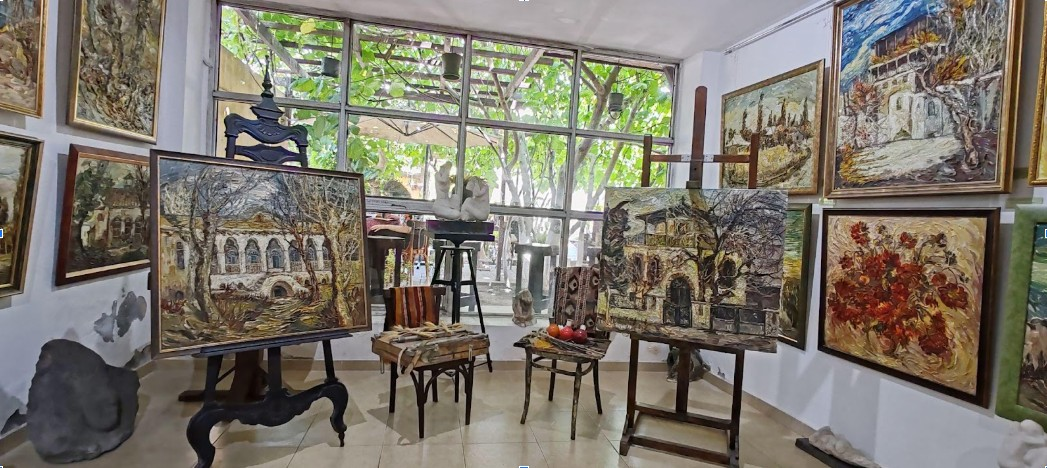
On a quiet street in Yerevan’s historic Erebuni district, the Lusik Aguletsi House-Museum welcomes visitors into a home that blurs the line between family and national heritage.
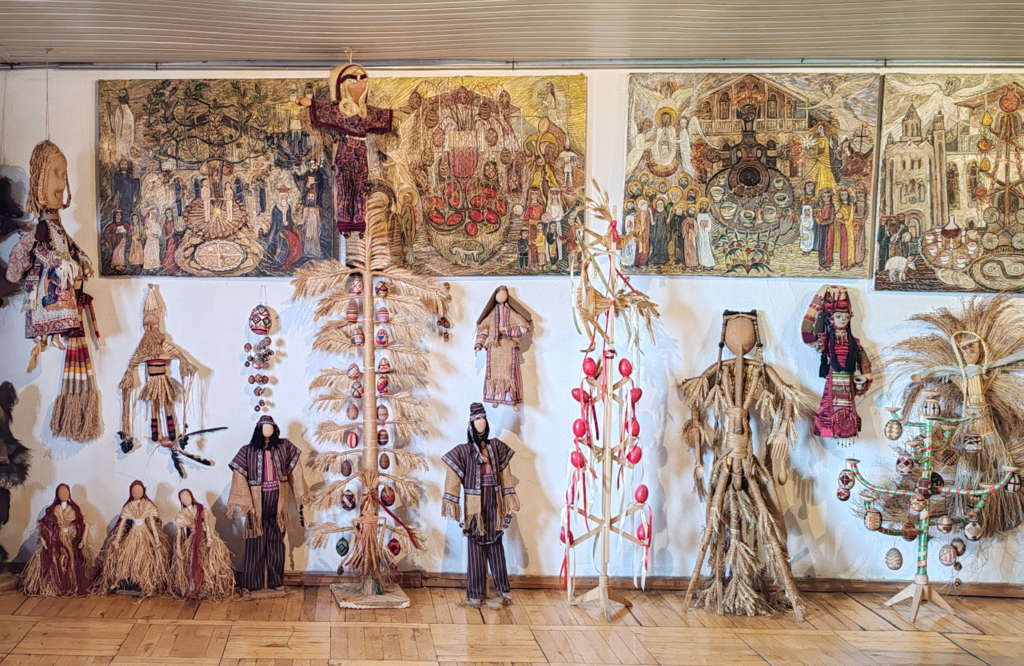
The museum showcases a unique blend of Armenian national dresses, jewelry, traditional housewares, and weapons, alongside artworks and artifacts collected and created by artist, ethnographer, and cultural icon Lusik Aguletsi and her family.
“We discovered this museum by chance,” said Alla Markova, a professor at Moscow State University, who arrived early with her daughter, Polina.
They had come to see the Erebuni Fortress and were searching for other museums nearby when Markova read about this one and suggested they stop in.
Though her husband is Armenian, her daughter wasn’t familiar with Armenia, and they came here to make new memories, Markova said.
“Personally, I’m amazed. It’s an extraordinary collection you won’t find anywhere else,” she said. “Even in Italy—in Turin or Milan—I’ve always been drawn to private collections. They’re unpredictable and incredibly impressive,” she said.
Summer is the busiest season at the Aguletsi House Museum, one of Yerevan’s 48 museums and 16 private collections, according to Armenia’s Ministry of Education, Science, Culture, and Sports.
“Most of our international guests come from the Russian Federation,” said Astghik Samvelyan, daughter of Lusik Aguletsi. “But we also have visitors from China, Japan, France, and other countries.”
In addition to foreign tourists, many members of the Armenian diaspora return to explore their cultural roots.
Yet, private museums in Armenia face significant challenges from financial hardships to difficulty gaining public notice.
Astghik Samvelyan emphasized the issue of visibility and lack of state support.
“Many visitors to Armenia arrive through state-run programs, which naturally guide them to public museums, though private collections are also part of the nation’s cultural wealth,” Samvelyan said.
She noted that private museums lack legislative backup and are not included in state support systems, which creates challenges in attracting local visitors.
Samvelyan pointed to the state-subsidized museum pass program as one key area where inclusion could make a difference. The program currently applies only to public museums, offering free or discounted visits to students, while the state compensates for the difference.
“The same system could be extended to private museums. It would not only help us financially but also allow schoolchildren and more locals to experience this part of their heritage.”
Some private museums remain closed for lack of funding, including the Sargis Muradyan Gallery, according to the Ministry. In some cases, physical limitations play a role. The Museum of Armenian Medicine, for instance, can’t accommodate group visits due to its small size. It only accepts five to seven visitors at a time, and only with prior notice.
The House-Museum of Dushman Vardan and the Arthur Gharibyan Museum are open by appointment, because their families still reside in the homes housing those collections.
Aguletsi house-museum’s model of sustainability
Originally opened to guests in 2013 and officially transformed into a public museum in 2019 following Lusik Aguletsi’s passing, this House-Museum is more than a place to explore historic or art objects.
“We like to say it’s a ‘touchable museum,’” said Gayane Samvelyan, the museum’s director and daughter–in-law of Lusik Aguletsi, recalling a German visitor who once hugged a clay jar for half an hour, overwhelmed by the feeling of holding something thousands of years old.
She explained that here visitors can interact with non-fragile artifacts, try on traditional Armenian costumes for photos, and enjoy dishes based on family recipes and traditional cuisine.
Unlike many museums in Armenia, the Lusik Aguletsi House-Museum has an art cafe — one of the few such concepts attached to a museum in Yerevan. But the idea wasn’t born from a business plan.
“The art cafe came about naturally,” Gayane Samvelyan said. “When it was still a home, our table was always full of dried fruits, nuts, and refreshments. After each tour, people wanted to linger, ask questions, so every visit ended around the table.
That tradition of hospitality has continued. Today, the cafe serves traditional dishes with modern touches, named after Armenian ceremonial dolls and holidays, “to popularize them.”
The museum’s sustainability is built on a diversified mix of income sources, including ticket sales, art cafe revenue, cultural masterclasses, photo shoots, and occasional film screenings.
The symbolism behind the house
The house originally belonged to the ancestors of Aguletsi’s husband, sculptor Yuri Samvelyan, who later expanded it around a tree planted by his grandmother, who fled Van amid the massacres of Armenians in the Ottoman Empire.
“The tree in the center of the house is symbolic,” said Astghik Samvelyan. “It’s like a living memory of their displacement. Interestingly, they didn’t talk about it that much.
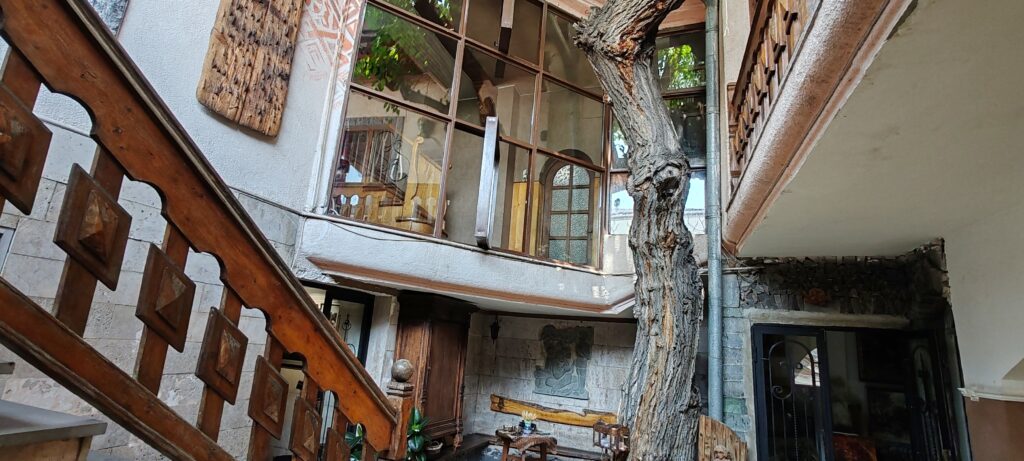
“The house grew up with my brother and me,” she added. “It’s two-sided now, but the part we’re sitting in didn’t exist before — it was added in the 1990s.”
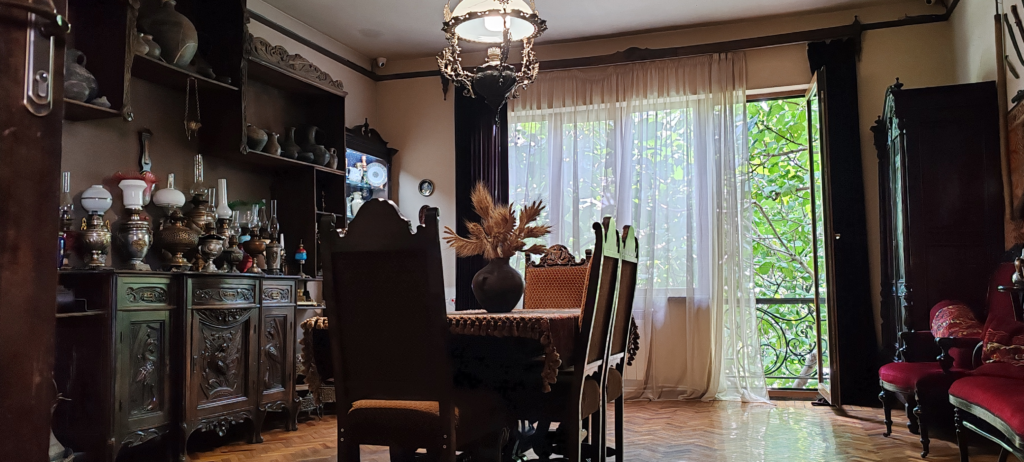
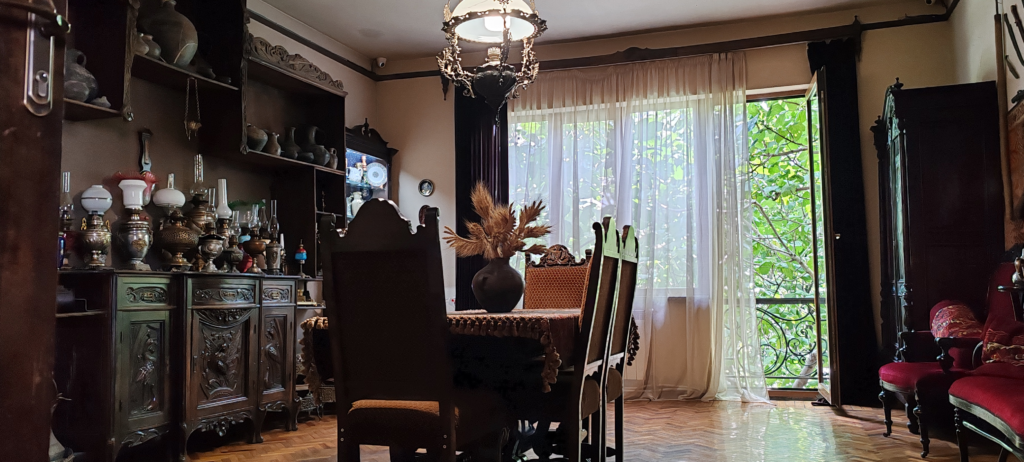
What we see now — the layout of the museum — is how the family actually lived.
“My mother brought her roots from Agulis and joined them with my father’s. Together, they created this treasure. It may enrich others, but for me, it feels empty without my mom and dad,” she said.
Among the many cultural artifacts preserved in Lusik Aguletsi’s house museum, one item carries a particularly personal history.
“She was deeply moved and excited by every item she collected,” said Gayane Samvelyan, the museum’s director. “But if we were to name one item with a special connection. The cradle.”
In 1986, during what would become her last visit to her native village of Agulis — then part of the Nakhichevan ASSR — an Azerbaijani woman offered Aguletsi a cradle, saying it had belonged to her father.
“She bought it without thinking much of the story,” Samvelyan said. But when she brought it home, her grandmother recognized it.
“Grandmother was upset that it had been sold,” Samvelyan recalled. “That cradle had rocked not only her father, but also Lusik herself, her three sisters, and her brother.”
After it was no longer needed in the family, she gave the cradle to an Azerbaijani neighbor. Years later, it returned full circle — sold back to the family.
“In a way, Lusik regained her childhood,” Samvelyan said.
Last remnants of Agulis
Lusik Aguletsi was eight when her family left Agulis, but her grandparents stayed in the village, and she continued visiting them every summer. In the late 1970s and early 1980s, they moved to Yerevan, but she still returned to Agulis — even after Azerbaijani families moved into her grandparents’ home.
“Her grandparents had been well respected in the village, and the locals welcomed her,” said Gayane Samvelyan.
During her final visit, while painting scenes of her ancestral village, Aguletsi was arrested by Azerbaijani security forces.
“They questioned whether she was documenting the village to claim, ‘My ancestors lived here, they built this,’” Samvelyan said.
“Her husband came to Armenia twice with official papers proving she was a member of the Artists’ Union and had the right to paint anywhere. He tried to show she wasn’t involved in politics,” she added.
Agulis was a village in the historic Goghtn province of Nakhijevan. Large-scale massacres in Lower and Upper Agulis in December 1919, followed by the region’s incorporation into Soviet Azerbaijan, gradually depopulated its Armenian residents, a process that peaked in the 1980s. By the end of the decade, amid rising tensions over the Artsakh independence movement and anti-Armenian pogroms, no Armenians remained.
After several days, Aguletsi was released.
“They told her husband, ‘Take her away.’ She had been arguing with the police nonstop for two days, and they were relieved to see her go,” Samvelyan said.
Back at the Azerbaijani family’s home, the man who had hosted her asked her to leave.
“He knelt before her and pleaded, saying his family would be exiled and no one could guarantee her safety,” Samvelyan said.
Aguletsi wanted to take the items she had collected during her visit, but he begged her not to.
“He promised to deliver them later — and kept his word. That was her final connection with Agulis,” Samvelyan said.