

Two minor earthquakes were recorded between June 25 and 28 near Martuni in Gegharkunik region and Spitak in Lori. No damage was reported, and many residents didn’t feel the tremors. Still, even minor quakes carry symbolic weight in a country that experienced the devastation of the 1988 Spitak earthquake.
Recent years have seen reminders of that past. Armenia still remembers the quakes that shook the country on the same date two years in a row.
Lusine Khachatryan, 36, recalled the events and the date—Feb. 13—without a pause.
“I remember both earthquakes very well. The first time, we went downstairs—we live on the fourth floor of a high-rise building. The second time, we stayed in,” she said.
In 2021, a 4.7-magnitude earthquake was felt at an intensity of 5 to 6 in Yerevan and the surrounding provinces. The following year, a 5.2-magnitude quake was recorded. It reached intensities of 4 to 5 across Tavush, Lori, Aragatsotn, Armavir, and Kotayk regions, and 3 to 4 in the capital.
When asked about the last time she read about a quake, she responded, “This morning.” Khachatryan admitted she barely gets triggered by this news anymore.
“I think people are getting used to it,” she said. “It starts to feel normal. You don’t even feel fear anymore.
“I’m not afraid. You just worry about the kids,” Khachatryan added, as she sat at a children’s playground on Atoyan Lane in Yerevan.
Commenting on how even minor earthquake reports can affect people, Anna Hakobyan, a psychotherapist of the Development Psychological Center in Yerevan, noted:
“It’s a layered issue,” she said, partly in Russian.
“From a public perspective, it’s better to be informed than under-informed. But frequent updates can make some people anxious, while others may lose their guard. Like ‘The Boy Who Cried Wolf,’ they might not react appropriately when a real disaster comes.”
Seismic risks and earthquake reporting in Armenia
“Earthquakes always happen,” said Suzanna Kakoyan, head of the Population Outreach Department at the Regional Survey for Seismic Protection of Armenia. “But by 1988, it was as if the country had forgotten its devastating scales. Spitak changed that. That’s why our Service was created—to reevaluate everything that had been overlooked.”
Her agency, founded in 1991 in the aftermath of the Spitak earthquake, oversees seismic monitoring, risk assessment and mitigation in a country that is located in the Alpine-Himalayan seismic belt — the second largest in the world.
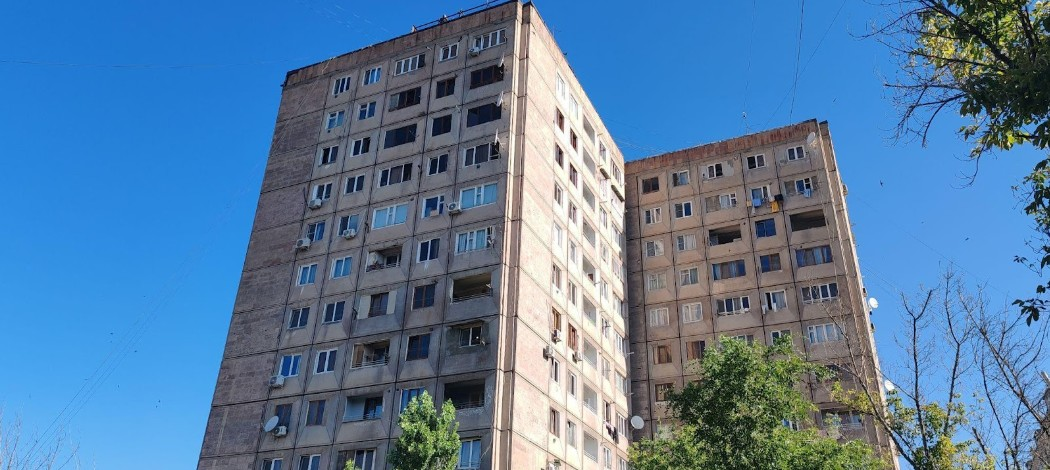
Kakoyan noted that while seismic hazard is highest in the northern part of Armenia, the risk is greatest in Yerevan because of its high population density and aging infrastructure.
“Most of the buildings here were constructed during the Soviet era for a 7-to-8 intensity threshold. But the hazard was underestimated,” she said.
“Add to that the way residents use them—adding floors, cutting load-bearing walls, turning basements into living spaces, building balconies that weren’t part of the original plan — all of this reduces seismic resilience,” she added.
As of 2022, 90 out of Armenia’s 19,183 apartment buildings were so vulnerable to earthquakes that they were uninhabitable, according to an Infocom report. Another 524 buildings were at the next-highest risk level, the report found.
The most hazardous buildings were in the regions of Shirak and Yerevan. Nearly half of all the building assessments were conducted before 2010.
Armenia’s local Pisa: Yerevan’s leaning towers raise a quiet alarm
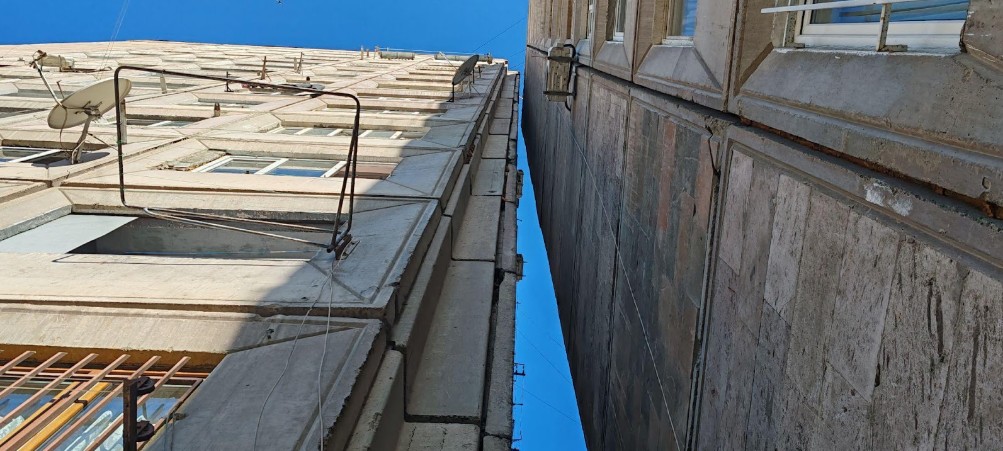
Just outside central Yerevan, two 14-story apartment buildings lean toward each other, their rooftops at 8/2 and 8/3 Artsakh Ave. separated by a mere 35 to 40 centimeters. According to the same report, the last time the buildings were inspected was 2004. The narrow gap, the 2023 Hetq report warned, puts the structures at “level 3” seismic risk — and they haven’t been inspected since 2004.
“They were tilted from the start,” said Haykaz Karapetyan, who lives near the buildings, while residents of 8/3 Artsakh Ave. declined to comment for this story. “Previously, the buildings were reinforced with concrete, at least up to the sixth floor.
“They’re strong buildings—stronger than others nearby,” he added. “But the tilt is real. It creates hardships for people — you open the door, it closes; you place something, it slides away.”
Hakobyan, of the Development Psychological Center, noted that avoidance is a common mental defense.
“Sometimes people are inclined to push away the thought that they live in a dangerous building,” she said. “Accepting it means taking action — like moving or selling the apartment. The mind finds ways to create an illusion that ‘everything will be fine.’”
She added that magical thinking can be part of that illusion.
“Some people believe ‘God is on my side’ and expect protection through good karma,” she said. “Whether it’s the state, God, or someone else, they shift responsibility and fail to act themselves.”
Hakobyan also noted that the government should be careful about the signals it sends to the public.
“If tall buildings are being built, it sends the message to people that everything is fine,” she said. “You are not given a sense to remain cautious. No matter how strong the technology is, when you go to Greece, which is also in our seismic zone, they rarely build over six floors.”
Preparing for the 45-second window
As noted by Suzanna Kakoyan, public awareness is one of the key components of seismic risk reduction.
“Starting from kindergartens and schools, we run education programs suited to each age group,” she said.
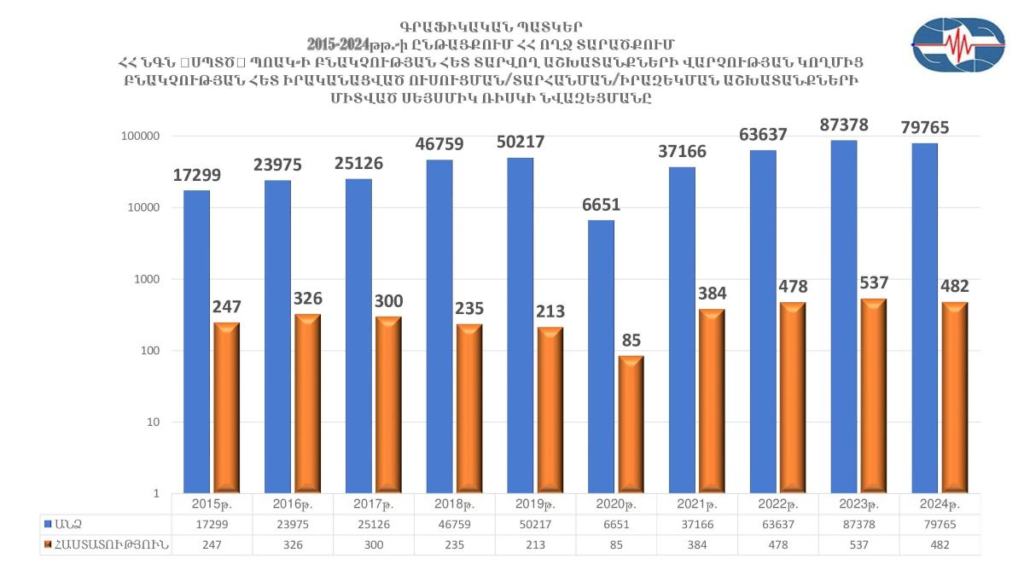
Yet, the state doesn’t enforce preparedness training to all organizations, and there is a line between the public and private sectors.
“State agencies and facilities are covered by our annual plans. For private organizations, it depends on their initiative.
“We’ve had good experience with banks, telecommunication companies like Viva Armenia, and hotels like ibis,” she said. “If an organization shows interest, we are eager to support them.
“In a real situation, you may only have 45 seconds to act, as we had in the case of the Spitak earthquake,” Kakoyan said.