


By Aida Gevorgyan & Mariam Sardaryan
“It’s my life, my decision, and I made my choice,” said Perchuhi Poghosyan, recalling the moment she ended her five-year marriage. For months, she had been “playing the role of a happy wife,” hiding what was going on behind closed doors.
Perchuhi’s story reflects a growing trend in Armenia. Divorce rates have seen a dramatic surge in the past three decades. Annual divorces have consistently surpassed the 4,000 threshold since 2021 and climbed to 4,689 in 2024, marking the highest level in 30 years at a time when Armenia’s population has shrunk, according to Armenia’s Statistics Committee (Armstat).
A review of Armstat’s statistical data through 2024, shows a clear upward trend of divorces. In the mid-1990s, divorces were relatively rare with no more than 2,000 divorces per year between 1998-2004. By 2024, that number had more than doubled to e 4,689 registered divorces.
By the early 2000s, the number of divorces began a steady increase. The crude divorce rate, which measures the number of divorces per 1,000 people in a population each year, reached 1.6 in 2024, whereas it hovered between 0.4-0.9 in the 1990s and early 2000s.
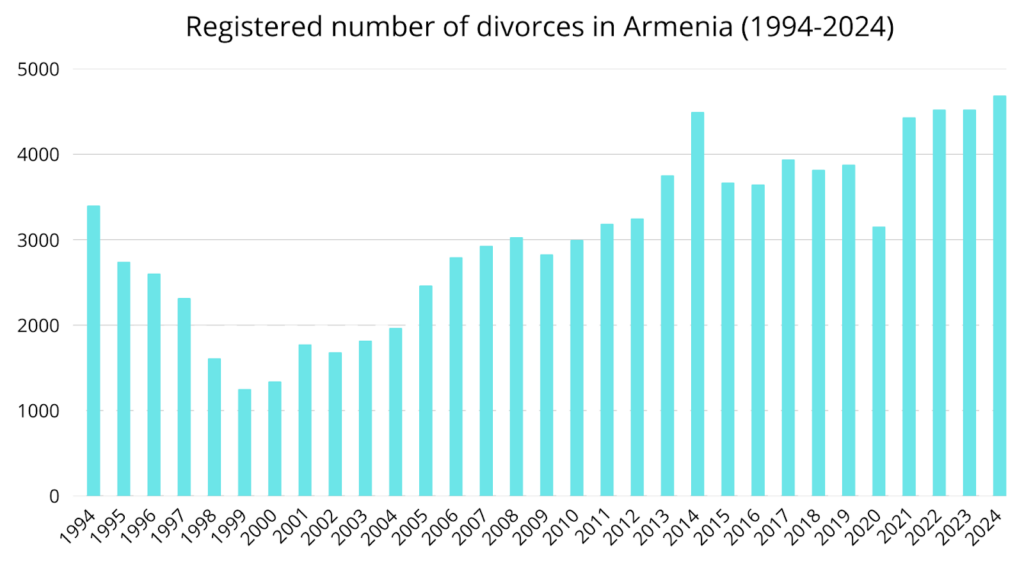
Table 1, Registered number of divorces in Armenia (1994-2024), Source: Armstat
The number of divorces have been increasing both in Yerevan and in the regions. However, the number of divorces per marriage is significantly higher in Yerevan. In 2024, there were 44 registered divorces for every 100 marriages in Yerevan. Lori and Vayots Dzor come next with approximately 29 divorces. Gegharkunik comes last, with only 15 divorces, almost half as much.
Table 2, The Ratio of divorces per 1,000 marriages, Yerevan/Regions (2021-2024), Source: Armstat
According to Armstat’s Population Census and Demography Division, official statistics capture only marriages and divorces registered by Civil Status Acts Registration bodies. Many unions go unrecorded, including , de facto marriages and divorces, as well as religious ceremonies not followed by civil registration. .
The fuller picture only emerges only during the national census which takes place every ten years. The 2022 Population Census, for example, identified 7,995 de facto separated couples. a. While census data depends on survey participants’ candor, the Division says that underreporting does not obscure the broader pattern: divorces are clearly on the rise.
Several factors drive the increase, chief among them shifting social attitudes. Divorce carries less stigma than it once did. In today’s marriages there is less pressure to stay in unhappy or abusive marriages. This cultural shift has given women greater autonomy in shaping their futures.
“I did not experience any negativity or change of attitude from others when I divorced,” Perchuhi said. “Though some friends tried to talk us out of getting divorced, I don’t regret my decision at all.”
One common pressure is the expectation to “stay together for the children”, but views on that are changing too.
“I could not be a complete person in that toxic family, not even for my children, ” Perchuhi said. “I can’t. And now that I look back, I understand that even when I was pretending to be a happy wife, that atmosphere was harming me and my children.”
Improved legal awareness also drives the upward trend.
“Women are now more legally aware than ever before,” said Anaida Simonyan, a lawyer and co-founder of Human Rights Power NGO. “Marriage is no longer perceived as an inviolable institution in society.”
As women gain greater legal protections, independence, and social acceptance, they feel more empowered to leave marriages that do not meet their needs. The shame of divorce has faded and women have moved beyond the expectation of staying in a marriage at any cost.
Increased legal awareness may also inflate divorce numbers by encouraging more couples to register their marriages, creating more unions that may be officially dissolved.
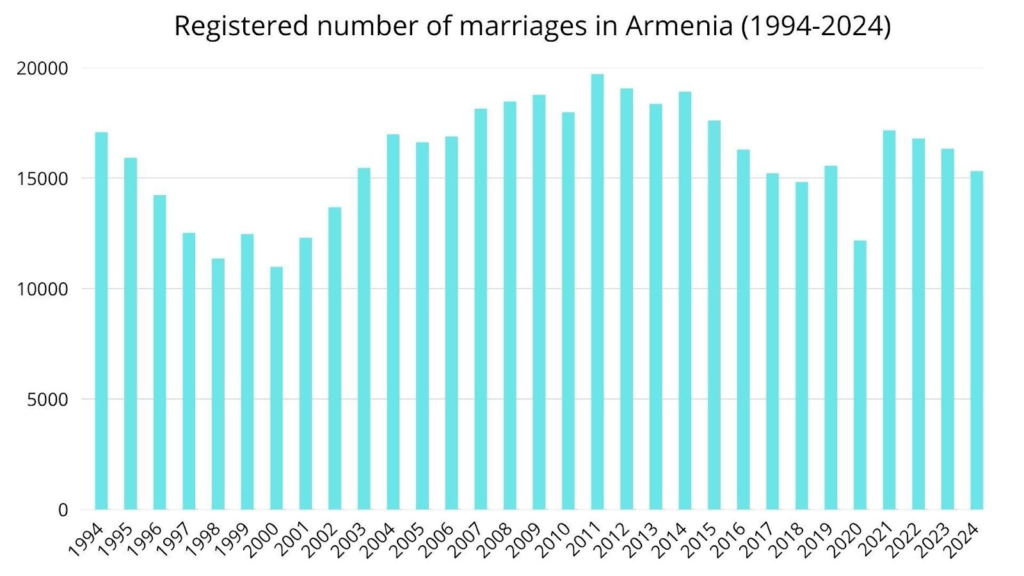
Table 3, Registered number of marriages in Armenia (1994-2024), Source: Armstat
Domestic violence is also pushing up divorce rates. According to Human Rights Watch, 1,535 criminal cases of domestic violence were filed in the first half of 2024, more than triple the 484 reported cases during the same period in 2023. But experts caution against reading too much into the spike because it may reflect greater willingness to report abuse than a surge in violence itself.
“The number of cases has grown largely because people report more,” said Zaruhi Hovhannisyan, a human rights defender and gender expert. “Public awareness has risen. People now know that the law protects them, that there are mechanisms and support services they can turn to.”
The violence takes many forms, including economic violence, she said, contributing to marriage breakdown. “Women over 40 used to think that “if he does not beat me, it is enough. They now understand that being banned from working, and blocked from participating in f society, or having their freedom of movement restricted, these are all forms of violence.” When women encounter economic abuse today, they recognize it for what it is.”
When they married, Perchuhi’s husband would take her whole salary.
“He created a stereotype for me that we have a problem and we should solve it together,” Perchuhi said. “I was totally up for that. But now I realize, it was actually me who was solving the problems. I was giving seven or eight times more than what I was receiving.”
A generation ago, women were expected to remain at home and unemployed. Today, many have successfully challenged that inequality. According to a 2021 International Finance Corporation report on women’s entrepreneurship in Armenia, most women-owned businesses belong to widowed or divorced women. These enterprises tend to be smaller and younger than male-owned businesses.
Yet economic pressures cut both ways. When husbands accumulate unpaid loans or taxes, the Compulsory Enforcement Service can freeze wives’ salaries if the husband lacks funds, prompting some couples to divorce on paper while remaining together.
“When hiding assets has become almost impossible, we have seen women legally divorce on paper, to keep at least one source of income,” Hovhannisyan said. However, this is a relatively new phenomenon and its role in the overall divorce rate is yet to be seen.
Despite the rise in Armenia’s divorce rate, the phenomenon is more widespread abroad. . The crude divorce rate in the European Union was 2.0 in 2023, with the highest crude divorce rates reported in Latvia (2.8 divorces per 1 000 persons), Lithuania (2.5) and Finland (2.1). The United States reported 2.4 divorces per 1 000 persons in 2023, compared to Russia’s 4.7, one of the highest in the world.Neighboring Georgia, with a population of 3.6 million people, has more than double the divorce rate as Armenia It reached 3.7 per 1,000 in 2024.
For many people like Perchuhi, the numbers reflect deeply personal choices. One year after her divorce she remembers explaining her decision to the kids as the hardest part.
“I didn’t know the kind of man he was, the divorce process made it clear.” Perchuhi said. “Despite all the stress I have been through, I have never regretted my decision.”