

For the Armenian diaspora, the distant southern province of Syunik often feels like a memory or a map line — something you point to on paper but can’t quite touch. Then, sometimes, a story changes that.
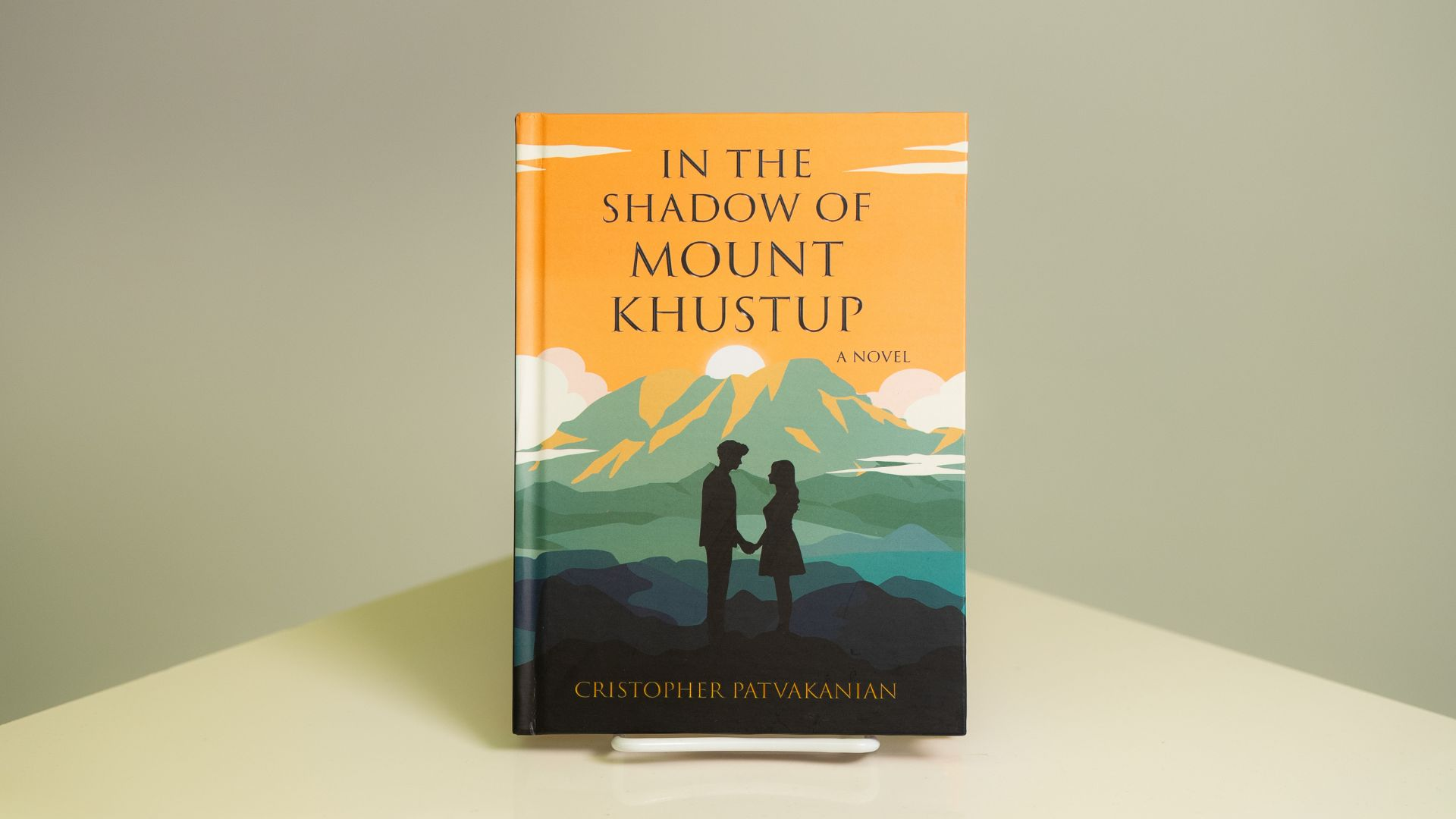
That bridge was recently built in the Akian Art Gallery at the American University of Armenia (AUA), when Christopher Patvakanian, a data scientist from Boston, took the stage. Before him sat an audience eager to listen. He wasn’t there to present numbers or research findings this time, but something more personal — his debut novel, In the Shadow of Mount Khustup.
The book follows a 2020 Artsakh war veteran returning to his ancestral village near Kapan, tracing a man’s struggle to find peace in a homeland still healing from loss. It’s fiction, but its roots are deeply real.
“We do not see fictional novels by Armenian authors or with Armenian themes in the English language, and even less so that are about the lives of people living in regions like Syunik,” said Laurie Alvandian, director of the AUA AGBU Papazian Library. “That’s what makes the potential impact of this novel so big, particularly for those in the diaspora whose main language is English.”
For Patkavanian, writing the novel was a homecoming of its own — one that began, fittingly, with data. Years earlier, he had set out on what he thought would be a family history project, combing through dusty archives and yellowed documents, tracing names and dates back to his grandparents’ birthplace in southern Armenia.
“I thought I was just collecting data,” he recalled with a smile. “But standing at my great-grandfather’s grave — the man I’m named after — and looking up at Mount Khustup, something shifted. It wasn’t research anymore; it was a connection.”
He describes the moment like stepping into a memory he didn’t know he had — the still air of the cemetery, the shadow of the mountain cast across the valley, the sense that history was alive beneath his feet. That scene became the emotional seed of the novel.
“There’s something about Syunik — the mountains, the history, the people — that pulls you in,” he said. “I wanted readers to feel that same mix of distance and belonging I felt there.”
Through fiction, Patkavanian found the language to explore that feeling. The novel’s protagonist, Khachik, carries both the weight of the war and the quiet hope of rebuilding — a reflection, perhaps, of the author’s own balancing act between reason and emotion.
“Fiction allowed me to tell emotional truths,” he said. “It gave me space to capture the authentic spirit of the people of Syunik — their resilience, humor and quiet strength.”
The duality — of pain and pride, belonging and exile — is something Alvandian said resonates deeply with diasporan readers.
“Christopher is familiar with the very diasporan feeling of both belonging and not belonging at the same time,” she said. “Feeling yourself both at home and as a foreigner.”
The audience that evening nodded along, many of them hearing familiar stories in new words.
“What struck me most was how real the setting felt,” said Lilit Khachatryan, one of the attendees. “Most people outside Armenia have never heard of Mount Khustup or Kapan. But through his writing, you can almost see the mountains, feel the weight of the silence and understand the people who live there.”
As the event drew to a close, the conversation turned to resilience — a theme that runs through both the novel and the author’s own reflections.
“They’ve seen things no one should ever have to see,” Patkavanian said speaking softly of his relatives who served in the 2020 war. “And yet, they wake up every day with hope. That resilience — that ability to smile after everything — that’s what I wanted to capture in the book.”
He isn’t done writing about Syunik. His next project, he shared, will weave together archival research and creative storytelling to explore the region’s cultural history — stories buried in family records, waiting to be brought to life.
Before leaving the stage, Patkavanian thanked the audience — many of them young Armenians who, like him, were born elsewhere but still feel the pull of home.
“Sometimes you don’t find your roots through history books,” he said. “Sometimes you find them through stories.”