

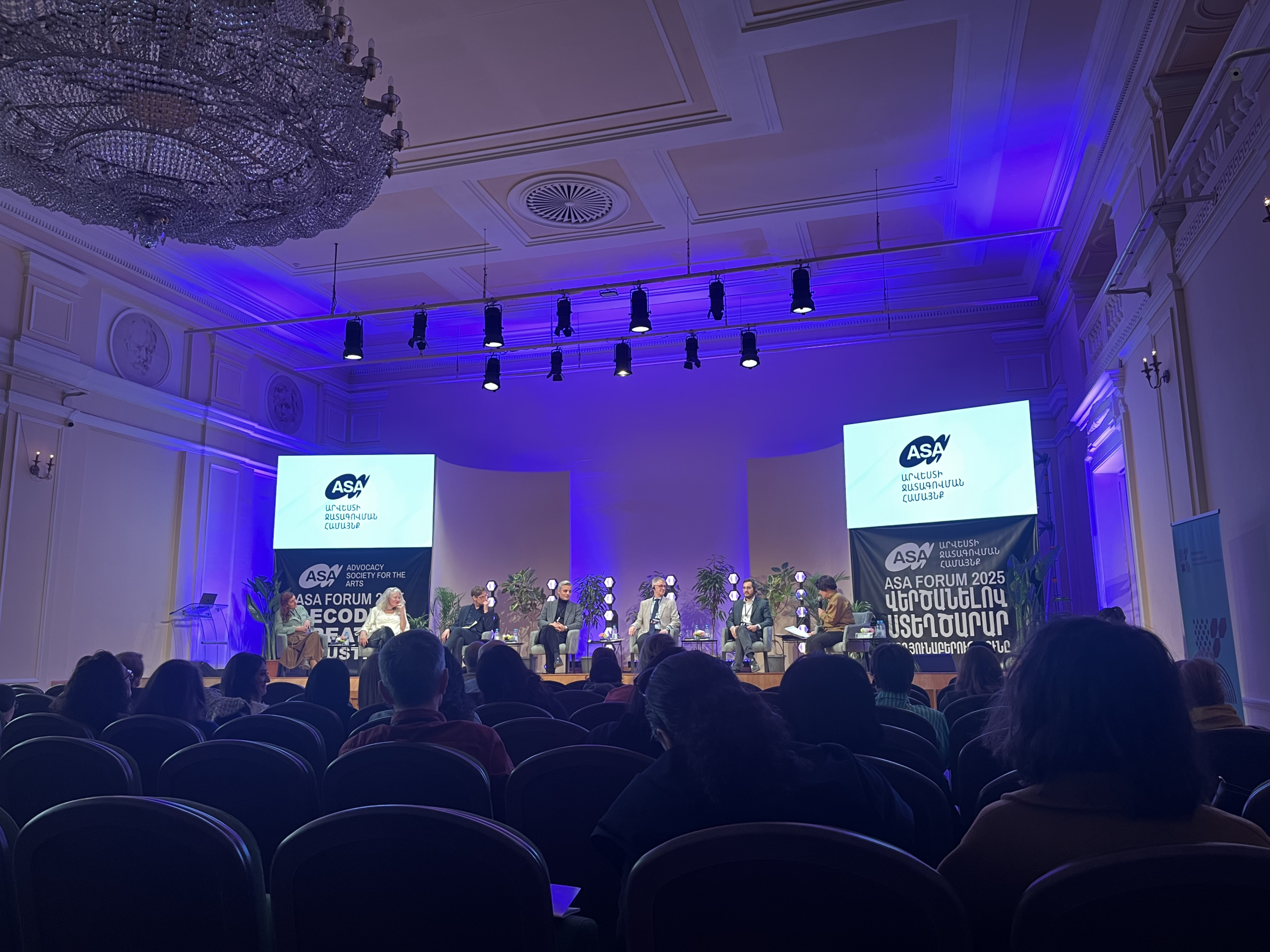
Under the soft glow of galaxy lights at the State Philharmonia of Armenia and a simple phrase “I have a dream,” the cultural community gathered within the framework of ASA Forum 2025 on Nov. 15 to reorder and to chart a daring vision for the country’s creative future.
The daylong event, titled “Decoding Creative Industries”, came to life through a collaboration with the Ministry of Education, Science, Culture and Sports of Armenia, the “Resonance” program, the Hosq foundation, and with the support of leading partners as the ArtNexus program, AGBU Armenia, and the JHM Foundation. It brought together art lovers, art creators and supporters in one place for a dialogue about cultural policy based on research and the formation of a sustainable creative economy.
“I have a dream,” said Magnus Kirchhoff, a representative of the Swedish Arts Grants committee. “…I have a dream that one day a creative community association would be formed in Armenia, uniting art lovers — and today we’re going to make the start.” After three years of supporting the AGBU “Katapult” program, Kirchhoff stated that it was a great event for him to see a large and caring audience come together to revive the pulse of the country’s culture.
Shoghakat Galstian, the project manager of ASA Armenia, told the Brief that this forum is one of the first steps the organization takes to rescue the situation in these limited circumstances, bringing artists and partner organizations together. “Those who fund the industry are also the ones shaping the model for the future,” she said.
Across several packed discussions and panels, participants, including Daniel Danielyan, deputy minister of education, Anne Torreggiani, the founder of the Audience agency in the UK, EUNIC Armenia President Jan-Tage Kuhling, and representatives of various branches of art explored the changing landscape of cultural production in the country, from funding gaps and the dangers of decentralization to digital transformation and data. Panelists noted that while Armenia’s creative sector remains competitive, it is also undergoing rapid changes.
“Engaging in culture in communities is both easy and very difficult,” said Gohar Mnatsakanyan from Sevan Youth Club NGO. Sharing the example of their organization, Mnatsakanyan assured that the field is not very crowded and makes it possible to bring every good idea to life, but at the same time, all responsibility remains on one entity.
Mnatsakanyan said that the problem of cultural decentralization is mainly being complicated by gaps in the allocation of the state budget.
“In the regions (of Armenia), the budget for cultural activities is allocated only for the maintenance of facilities and it is mostly not enough for additional activities,” she said.
Panelist Tigran Jrbashyan, head of the Ameria consulting company, offered a different view, describing the cultural industries as “a sector that requires the least capital investment” that can develop simply by forming Creative Hubs and providing resources to artists for collaborative creation. He assured that it would become truly applicable in our country.
“By international standards, this sector, from fashion to photography, animation, and VFX, is one of the fastest growing in our country,” Jrbashyan noted.
Summing up the conversations, Danielyan, emphasizing the importance of every citizen’s access to culture, promised to launch and consider all proposals of the event and be helpful in its implementation.
Between sessions, Anne Torreggiani held a multi-layered discussion about data. Opening up a huge world of numbers, she presented the importance of the proper relationship between data and people.
“Data is not subject to emotional or bias influences, maintaining objectivity. However, the value of data is fully revealed only when it is studied and used by professionally trained, literate people,” Torreggiani said. “Sometimes data doesn’t work as good as our instincts.”
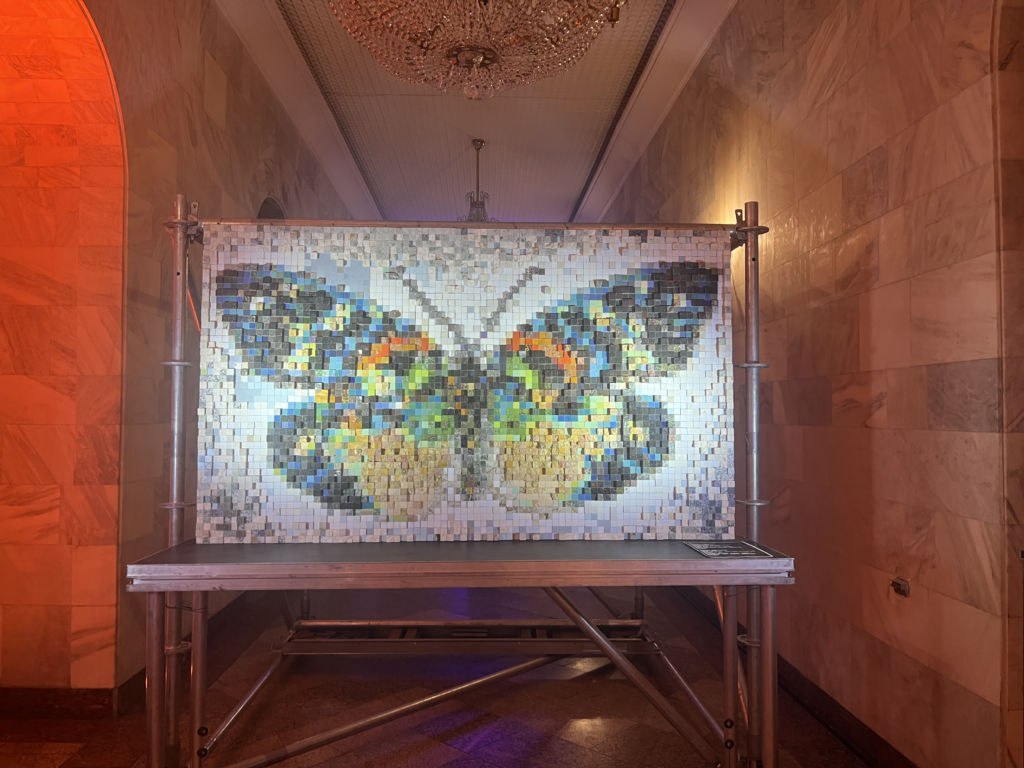
Every inch of the venue itself spoke about culture. Even before stepping into the hall, an exhibition had already drawn guests into the momentum of the day, featuring Armenian artist Siranush Aghajanyan’s Butterfly N14 mosaic from the “Post-War Butterflies. Love(fall)” series, made of marble, tuff, granite, onyx, and ceramic. “We are different, yet together we form a mosaic of ideas, stories, and visions. Just like the marble butterfly,” ASA compares itself to this butterfly, which, despite weighing 90 kg, exudes the lightness of flight, just like Armenian creators, daring to go into the unknown, with seemingly light but heavy flights.
The event was also combined with the presentation of the KeepOn Live European Concert Hall Management Platform, aimed at developing a live music culture in Armenia, and a platform for open discussion on cultural art.
The evening concluded with the B2A “Business to Arts” awards ceremony. The awards were presented to Background Production, “Yerevan” Brandy Factory, Altech Group, and others.