

From upcycled denim to zero-waste designs, Armenian designers reimagined waste into style, joining the global movement towards sustainable fashion.
On Oct. 24-26, the third edition of Yerevan Fashion Week 2025 brought together emerging fashion designers and over 60 brand and international experts, with sustainable fashion standing out as one of the central topics.
The fashion industry is notorious for being one the biggest polluters in the world. According to the UN Environment Programme, the fashion industry accounts for up to 8% of global greenhouse gas emissions and consumes 215 trillion litres of water annually- the equivalent to 86 million Olympic-sized swimming pools. The industry also relies on chemicals, many of which are harmful to human health and ecosystems.
To alleviate such consequences, many fashion retailers and design houses today have introduced initiatives aimed at reducing the environmental impact. Yerevan Fashion 2025 joins this global cause.
One of the highlights was the Fashion Scout Armenia 2025, a competition for emerging fashion designers in Armenia. Open to local designers under 35, the award encourages creativity, craftsmanship with a special focus on sustainable practices. Among the prizes is the participation at Fashion Scout’s catwalk show during London Fashion Week, a great opportunity for the new designers.
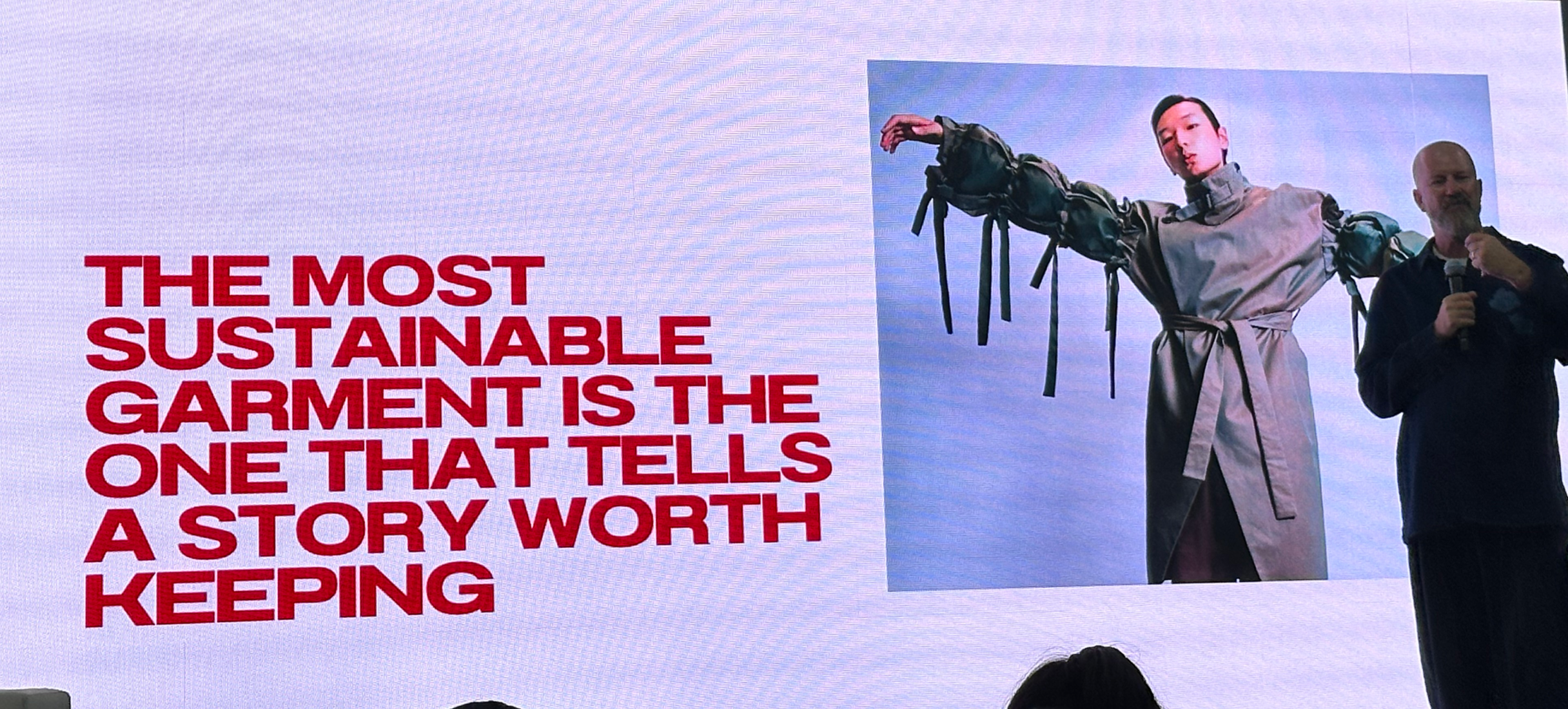
During panel discussions, Martyn Roberts, founder of Fashion Scout and Biljana Poposka-Roberts, the platform’s director, urged young designers to find balance between creativity and responsibility.
“Fast fashion has devalued fashion,” Roberts said “I once saw two women with huge shopping bags from Primark, and at some point some clothing fell out of one woman’s bag. She stopped, looked at it and just carried on walking. That clothing had so little value to her, both money-wise and emotionally, that it was not worth her stopping to pick it up.”
That is why Roberts said he is promoting sustainable practices through his platform as part of mentoring new designers.
“People want change and we see the change,” Roberts said. “During our first time as Fashion Scout in Armenia the vast majority of applicants didn’t actually understand our questions about sustainability. Now the knowledge is growing.”
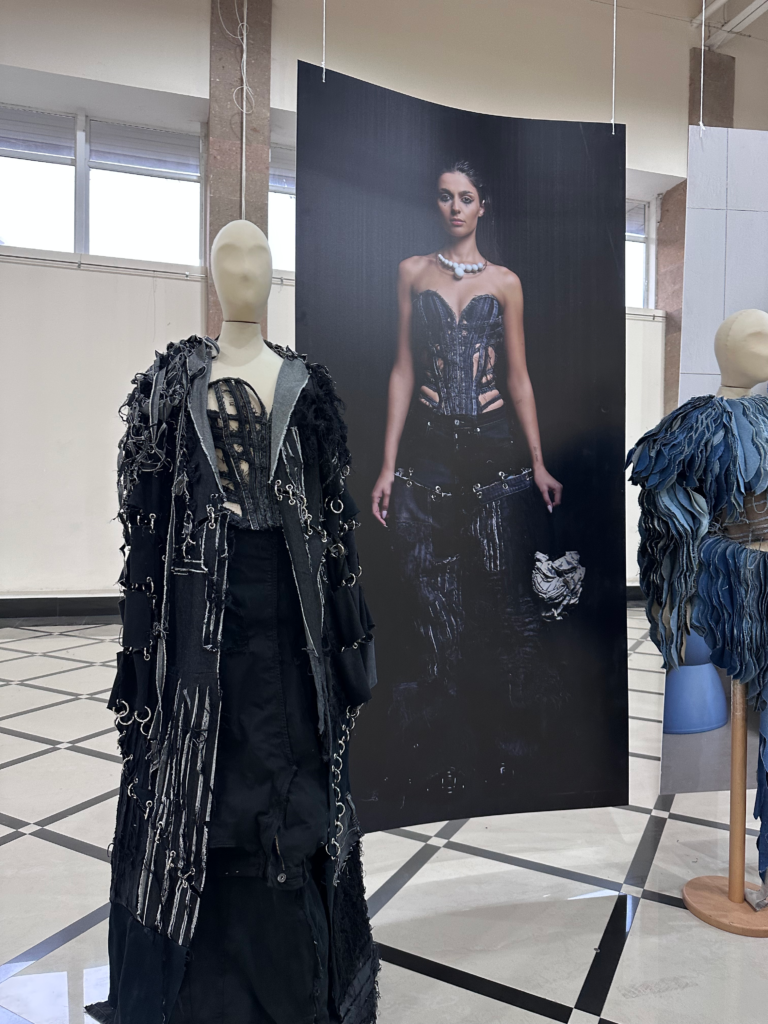
The message was echoed through the “Denim Cycle” initiative- an upcycling project launched by the Fashion and Garment Chamber (FGC). Yerevan residents were asked to bring and leave their old jeans in special donation containers. Those pieces were later upcycled in CreLab Kotayk and Crelab Tavush, where students together with professionals turned the worn-out old pieces into a new runway collection.
“It is a reimagining of a beginning,” FGC said. “Through upcycling old denim and deconstructing classic forms, it creates a fashion language built on mistakes, imperfections, and the honesty of materials.”
Roberts warned of the overuse of the term “sustainable” nowadays.
“Brands such as H&M talk about sustainable collections,” Roberts said “But it’s almost greenwashing, they are saying something but the actual reality is something else. It is a very hard thing for a designer to say this is sustainable.”
Piece of DENIM CYCLE – Nelly Serobyan’s Group, exhibited at Yerevan Fashion Week 2025, Oct. 26, photo by Aida Gevorgyan
Armenian designers are increasingly adopting practices that reduce the environmental impact. Fashion designer Galine Vardanyan, founder of Galine Galine, is experimenting with zero-waste-cutting techniques to bring down textile waste to almost nothing.
“When cutting for a sweater, 15% of unused clean fabric immediately goes to waste,” Vardanyan said. “We are trying to design those patterns in a way that zero waste is generated.”
Vardanyan said she is not reinventing the wheel since that kind of methodology existed long ago.
“For example, Japanese kimonos were zero waste,” Vardanyan said. “But it is very difficult and complex, and it comes with its own challenges.”
According to Vardanyan, there are actually many brands in Armenia that pursue sustainable practices. Among those are Woolway, which uses only natural and plant-based dyes, Z.G.EST, designed entirely from biodegradable and surplus stock and Skesoor Mama (Mother-in-law) Atelier, which collects unused fabric from people and grinds those into stuff such as pillows.
“For such practices you need money, campaigns, skills for the business to emerge as a successful brand,” Vardanyan said.
Despite the challenges, increasingly more Armenian designers get involved in responsible fashion practices and there is a big potential ahead.
“You are very lucky,” Roberts said. “Armenia is on the rise. People are seeing and talking about what’s happening here.”