

The Museum of Russian Art marked its anniversary with a small retrospective dedicated to Anahit Fljyan, the institution’s longtime director, designer, and art scholar. The exhibition, on view from Nov. 19 to Dec. 11, is installed in a single room and presents a modest selection of her gouache and watercolor works, along with several publications and archival materials that reflected her broader cultural interests. It provided a brief look into the artistic side of Fljyan, who was usually known for her institutional leadership.
The exhibition was situated in a compact, dark blue room. The lighting was soft, and most works were small in scale, framed simply on the walls. A central glass vitrine displayed Fljyan’s books and research materials, including writings about Arno Babajanyan, the city of Ani, and other items. These items highlighted her interest in visual art, music, and broader cultural fields.
Two works titled Esquiz (Sketch) displayed side by side.
Photo by Zhanna Kuroyan
The scale of the exhibition was modest. Given Fljyan’s long career, the limited number of works on display created an impression that a larger scope might have been possible. Nonetheless, the selection made clear that her artistic practice leaned toward structure, clarity, and simplicity.
Fljyan’s visual language includes structured compositions, muted tones, and simplicity. The pieces shared common features, such as clean outlines and geometric arrangements, reflecting a design-oriented approach.
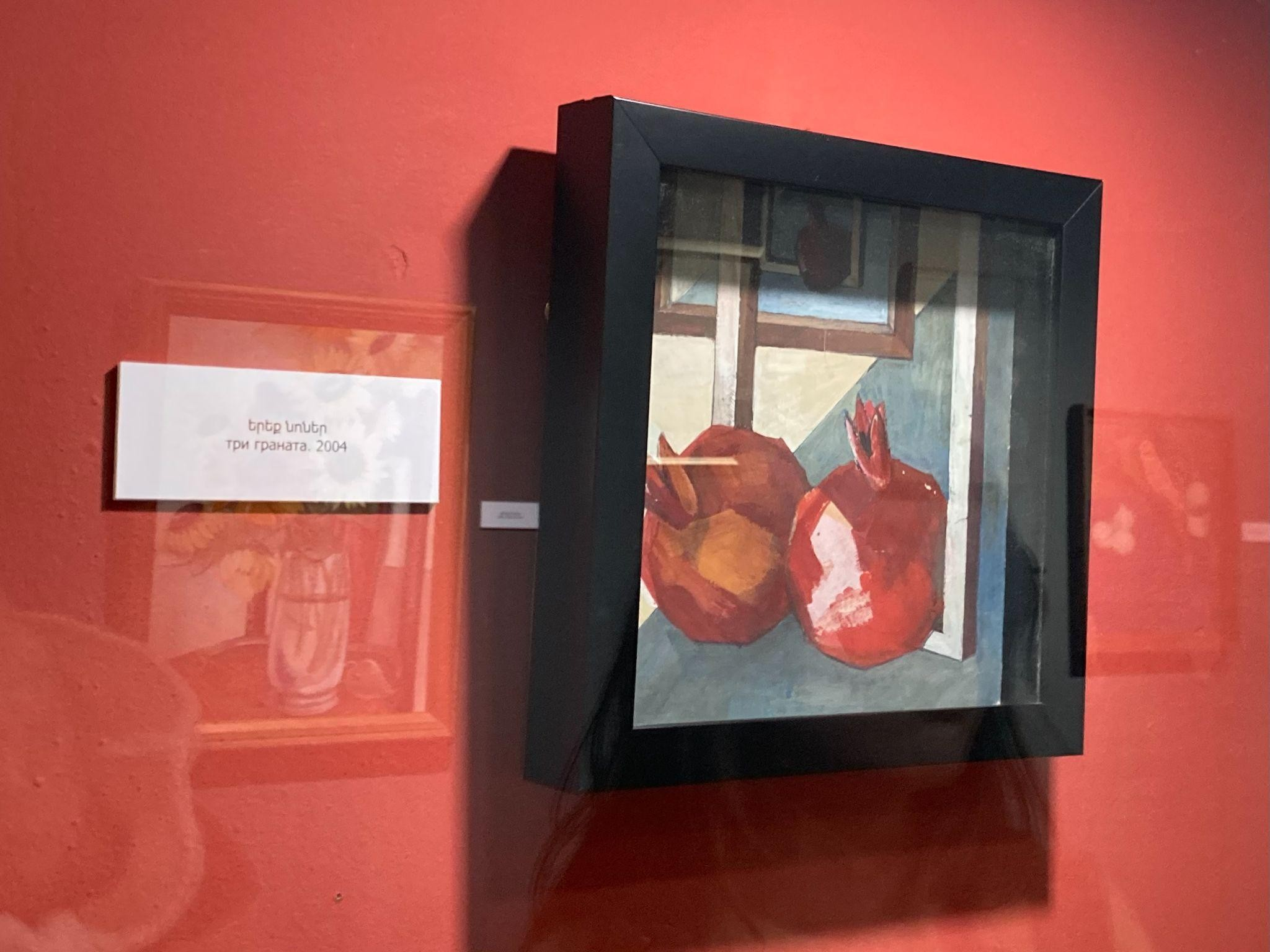
One piece, Three Pomegranates (2004), features three pomegranates arranged within a layered, geometric set of “framed within frames.” Two large pomegranates occupy the foreground, painted in broad, flat areas of red and orange, which give the fruit a solid, sculptural appearance. A third pomegranate appears behind them, smaller and less defined, positioned within rectangular shapes that resemble window frames. These overlapping frames make the background appear divided into separate sections, giving a structured, yet slightly disoriented feel.
Three Pomegranates exhibited on the central vitrine.
Photo by Zhanna Kuroyan.
In Gushakuhi (The Fortune Teller, 1989), a woman is depicted with her head gently lowered to the left, and gazing down. Her face is formed with smooth, continuous lines, with her dark hair curved around it. Her clothing feels flowy, blending into the surrounding space, where the background is divided into rectangular sections of beige, brown, and olive colors. At the lower corners, two clusters of long, pale green leaves appear, echoing the shapes of the clothing. The overall composition creates a quiet scene, where the figure, clothing, and the scene are in one, structured arrangement.
The Fortune Teller displayed on a gray wall.
Photo by Zhanna Kuroyan
The painting titled Shog Ashun (Hot Autumn, 2002) shows a cluster of slender, tall trees, painted in bright reds, oranges, and yellows. Behind them, muted patches of pale blue appear, while the ground is covered in different shades of yellow strokes. Seen during autumn, Shog Ashun carried an atmosphere familiar from descriptions of the season in Russian literature and Soviet era illustrations: warm colors, simplified forms, and stillness rather than motion.
Hot Autumn displayed in the exhibition.
Photo by Zhanna Kuroyan.
Beyond individual works, the exhibition reflected a broader historical relationship that shaped both Fljyan’s career and the museum she managed. This connection was also reflected in the comments of the museum guide, who preferred to remain anonymous [SM2] and described the artistic exchange between the two cultures. According to the guide, Russian painters worked and taught in Armenia and other parts of the Caucasus, contributing to the local artistic development and visual language.
“Fljyan had to know the history of Russian art,” said the guide. “And she knew ours just as deeply.”
When asked why Russian culture matters for Armenians, the guide gave a simple answer.
“Russian culture must be known because it is inseparable from ours. It doesn’t matter if it’s Chinese, Japanese, or Mongolian: culture should be known. But with the Russians, we have very much in common.”
Overall, the exhibition provided a brief but informative overview of Fljyan’s artistic and cultural work. The limited scope left certain aspects of her artistic work unexplored, but the selection made clear her visual language and role as a researcher. Presented in the museum of Russian art, the exhibition recognized her role in navigating that cultural intersection.