

Ahead of Armenia’s 2026 parliamentary elections, many young voters are once again staying on the sidelines—unsure if their voices matter, unconvinced by political options, and in some cases unwilling to participate.
With Armenia’s June 7 parliamentary elections approaching, a recent survey published by the International Republican Institute (IRI), offers a clear picture of youth sentiment. About 34% of Armenians ages 18 to 35 remain undecided about whom they will vote for, while 14% claim they will not participate in the election at all. No political party, among the 19 registered political forces, has secured strong support among young voters, whose preferences remain divided.
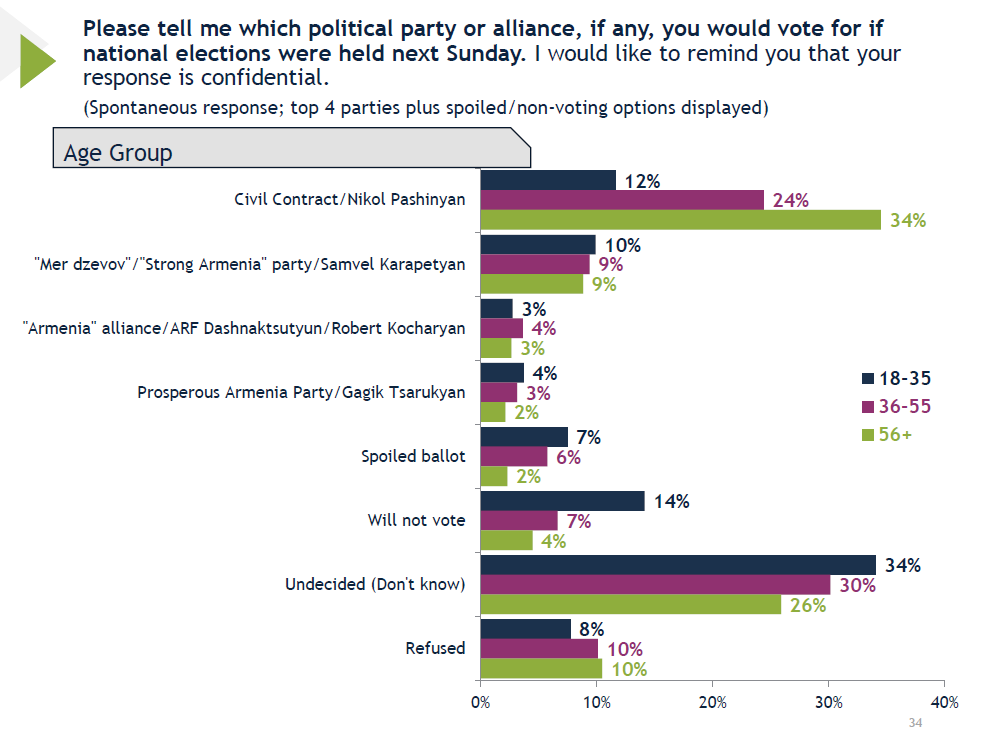
A snippet from the survey published by the International Republican Institute (IRI) on March 5, 2026. Source: ©2026 International Republican Institute
While Armenia does not publish official turnout data disaggregated by age, the Chair of the Central Electoral Commission Vahagn Hovakimyan says younger voters are consistently less likely to participate. That suggests Armenia may be heading into another election cycle where its youngest citizens remain the least represented at the ballot box. Hovakimyan, however, views this as a normal pre-electoral pattern.
“In my view, lower participation among young people is typical in democratic countries,” he says. “As societies stabilize, younger generations tend to disengage from politics, while periods of crisis often bring them back into active participation.”
Yet the explanation of “normal disengagement” does not resonate with the perspectives of young voters themselves.
“…no political party fully represents my views,” says Hrach Arzumanyan, 24, a senior studying politics and governance at the American University of Armenia (AUA). “I think youth are underrepresented; there are not enough young parliamentarians or actors who genuinely advocate for younger generations.”
Others have a different take on young people’s disengagement. Narek Nuroyan, an 18-year-old student, who will be voting for the first time this year, says the process gives him a chance to make a big decision as a young adult.
“My biggest motivation is that I have a chance to participate in deciding something that can be important for my country’s future,” he says, adding that every vote is important in the process. Arzumanyan disagrees.
“Realistically, one individual vote does not decide election outcomes, but aggregate behavior does,” he says.
This difference points to a more complex issue than a simple disengagement. For some young voters, the issue is representation, while for others, it’s whether individual participation brings political change.
“Today’s younger generation is apprehensive, they don’t trust anyone,” says Dr. Jenny Paturyan, Chair of the Bachelor of Arts in Politics and Governance program and associate professor at AUA. Paturyan says the war and its aftermath have had a lasting impact on young people. After witnessing the optimism of the 2018 revolution, when mass protests led to a change in government, many people then experienced the trauma of war, displacement, and ongoing security threats. As a result, the younger generation is now more cautious, usually unsure of their choices and more aware of the potential consequences.
At the same time, she sees this shift as a sign of growing civic awareness. “We are witnessing times that people are beginning to understand the real responsibility and care about the country,” she says. “There’s no right choice, so even if you don’t know who to vote for, go and make sure you show up.”
However, for some young voters, that sense of responsibility often lives alongside uncertainty and doubt. Another 18-year-old voter, Tigran Elbakyan, notes, “I think young people’s opinions play an important role in politics, which is why political parties tend to pay close attention to youth engagement nowadays. But I don’t believe in any of them.”
Elbakyan’s observation is a recent trend. Some politicians’ official social media pages usually adopt informal or entertainment-style content formats, including trend- driven videos, meme-based posts or short conversational clips designed to attract younger voters. This approach is used in the communication style of Prime Minister Nikol Pashinyan, whose social media presence frequently includes informal video messages and widely used trends to engage with the younger generation.
A similar shift is visible in the online presence of Robert Kocharyan, who has adapted his messaging to appeal to younger audiences, moving away from more traditional campaign methods. His strategy appears to rely in part on the public profiles of his family members to connect with younger voters, particularly his son, who is also a part of the political alliance.
Paturyan stresses that young people should not rely on social media as their primary source of information, warning that it significantly shapes their consumption habits. As social media news feeds are driven mostly by algorithms, they can create bubbles that limit access to diverse perspectives and risk disconnecting from reality, especially for younger users.
Appealing to the younger generation seems to have become a strategic priority among different political parties. While political actors continue to compete for the attention of young voters, the deeper problem remains: not only as to how to reach them but also how to convince them that their participation matters.