

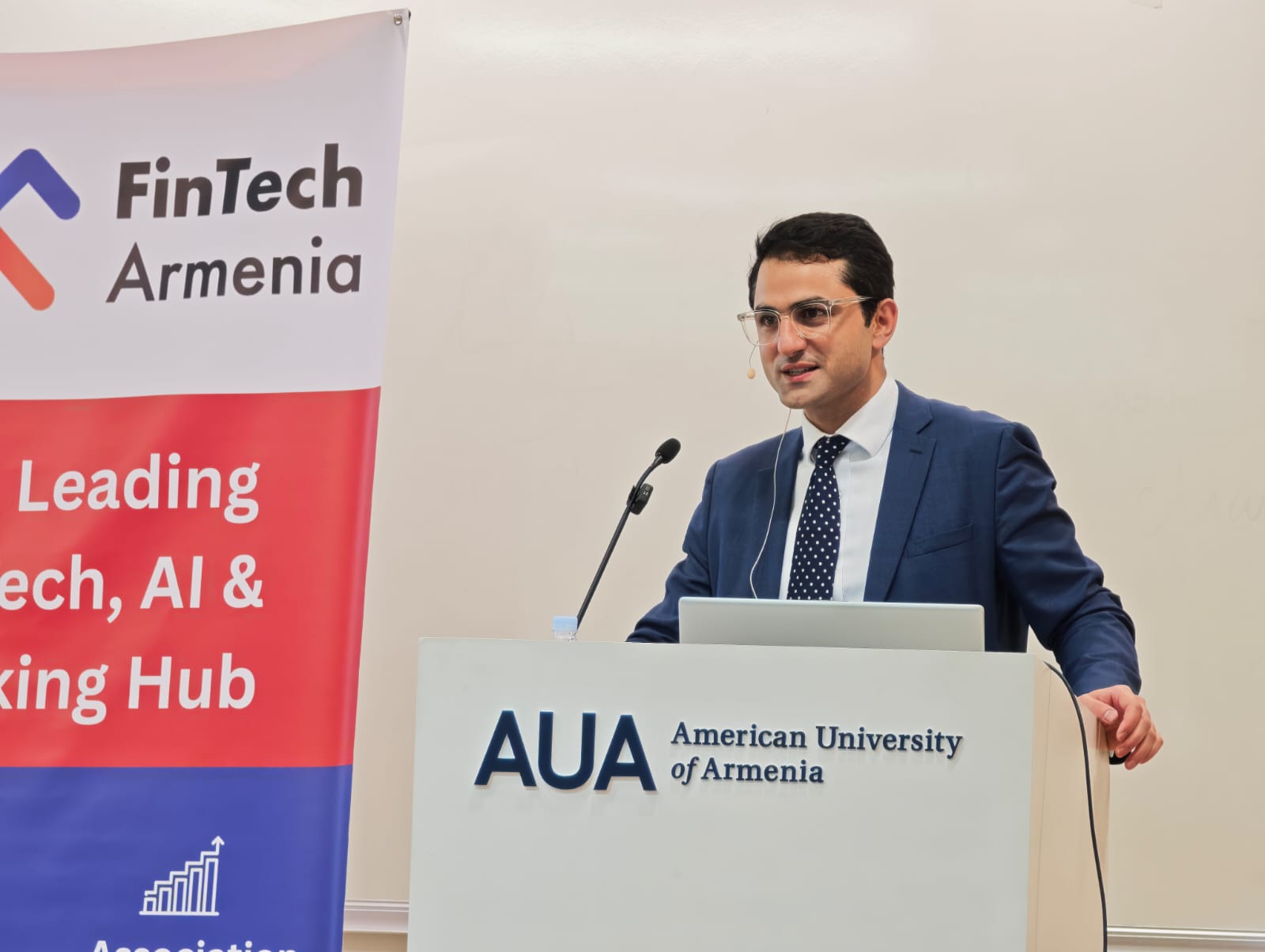
On April 17, more than 200 executives, founders, and technologists gathered at the American University of Armenia for FinTech Day Armenia. The event, organized by FinTech Armenia, drew C-suite and tech leaders from over 90 firms across the local fintech sector to discuss the opportunities shaping Armenia as a regional fintech hub. It also provided a platform for startups in the industry to talk about their products.
“Financial technology has clearly fundamentally changed the way we trade and transact and think about money and wealth,” said AUA President Bruce Boghosian in his opening speech. “This kind of industry conference will no doubt help strengthen and improve connections between local and international market participants.”
With 35 speakers from banks, insurers, payment companies, and startups, the conference covered a range of topics, including banking transformation, insurance tech, trade technology, artificial intelligence for financial services, distributed ledger technology, and crypto case studies. For Stefan Lucas, the founder of FinTech Armenia, the conference was exactly what the industry needed.
“FinTech Day Armenia was our inaugural industry conference, aimed at both existing founding FinTech Armenia members and the broader fintech industry,” Lucas said.
The conference welcomed leadership from Arca, Byblos Bank, Nairi Insurance, and others, alongside 23 local and international startups across fintech and financial services segments.
Lucas noted that FTA currently has over 40 member firms, spanning banks, payment companies, insurers, telecommunications companies, credit providers, AI platforms, software developers, and crypto startups, as well as more than 65 global partners, including conferences, investor networks, educational institutions, and PR platforms.
Through FTA, he aims to connect Armenia’s domestic financial market with the world beyond it. He hopes to position Armenia among the top 15 global fintech hubs by 2041.
“Our vision is to exponentially grow the fintech market and industry,” Lucas said. “We’re onboarding existing market participants across all financial services and financial technology, and we’re working with firms to help them achieve their fintech goals and ambitions.”
In the near term, he sees the sector’s acceleration as the defining trend.
“I fully expect the industry’s growth to accelerate and for the adoption of nascent innovative tools, solutions and technologies to accelerate across mainstream industries from payments, to banks, insurers, to telcos, software, and mainstream e-commerce, trade and commercial businesses,” he said.
Lucas also notes that fintech has a tangible human impact.
“FinTech will improve lives by automating processes, thereby helping institutional businesses and every day retail individuals to save both money and time. Both unique selling points are very key for humans to live a good and better life,” he said.
Davit Abgaryan, founder of AI fintech firm Abda AI, offered a grounded assessment of why Armenia’s fintech sector has made real progress. He argues that several forces are converging, rather than any single catalyst.
“Armenia has a relatively strong and well-regulated banking system, with the Central Bank playing an active role in modernizing payments and financial infrastructure,” Abgaryan said.
He added that cashless payments, digital wallets, QR payments, and online banking systems have become much more common.
A representative of one bank at the conference confirms this drive for modernization.
“It’s a journey to move beyond traditional banking, to embrace the future built on agility and customer-centricity,” said Suren Voskanyan, head of digital innovation at Byblos Bank Armenia, speaking at FinTech Day Armenia. “We are not looking for a change just for the sake of the change. Our strategic direction is a focused roadmap to modernize our internal processes, to improve our decision-making capabilities, and to prepare Byblos Bank for the next generation of banking services.”
Armenia’s booming tech culture also plays a major role in fintech product development.
“The country has a strong engineering culture, many experienced software developers, and a growing startup ecosystem,” Abgaryan said. “This makes it easier to build fintech products locally and serve both Armenian and international markets.”
One recurring setback is the relationship between fintech startups and traditional banks. Armenian banks are technically capable and financially stable, but collaboration remains uneven.
“Collaboration is often slowed by slow decision-making, a lack of startup mindset, and limited proactiveness in adopting innovation,” Abgaryan said. “Technology is still sometimes seen as a support function rather than a strategic driver.”
He added that banks need to adopt faster decision cycles, venture-style thinking about partnerships, and a willingness to look beyond the local market.
“Thinking regionally and globally would make them much stronger partners and investors in fintech,” he said.
Both Lucas and Abgaryan pointed to regulation as the sector’s most influential factor. The Central Bank of Armenia recently launched a public consultation on innovation in the financial system, potentially allowing startups to test products in a controlled environment.
“My personal hope is that this consultation will give birth to a sandbox environment, to help attract, better understand and eventually release novel innovative forms of financial technology, perhaps in a regulated manner in the future,” Lucas said.
Abgaryan has a more reserved perspective. While he welcomed the direction, he noted that the government lacks a clearly articulated fintech strategy.
“The direction is promising,” he said, “but Armenia still needs a more visible, structured, and startup-friendly fintech policy framework.”
The gap between stated intent and practical implementation, he warned, could define whether or not Armenia takes advantage of its momentum.
Perhaps the clearest signal of Armenian fintech’s evolving ambition is the mindset of its founders. According to Abgaryan, Armenia is a base, not a ceiling.
“We see Armenia primarily as a launchpad for global scaling,” he said. “It’s a strong base for building and testing, given the talent and ecosystem, but the local market alone is too small to support venture-scale outcomes.”