

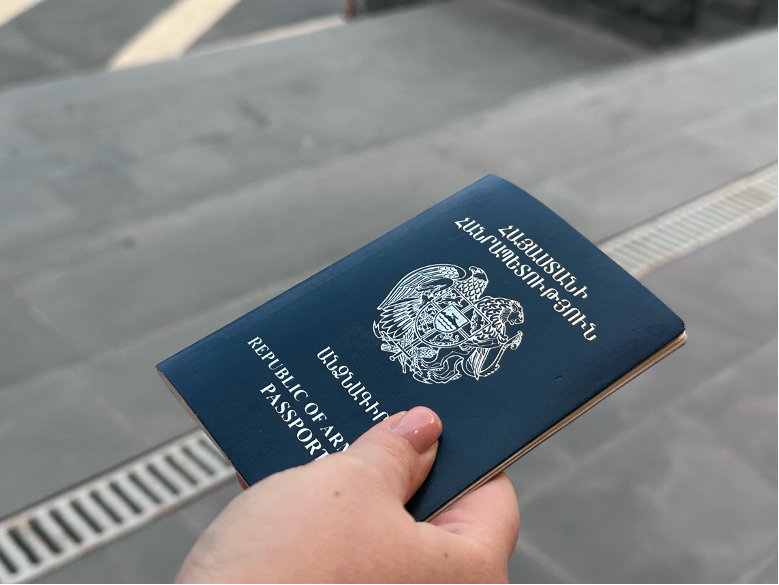
When Ella Airiianc moved with her husband to Armenia in 2022, she felt an immediate sense of belonging and decided to apply for Armenian citizenship. Thanks to her Armenian roots, the process was relatively smooth and fast, while Artem Sukhoroslov, a Russian citizen without Armenian descent or ties to Armenian nationals, underwent a longer path.
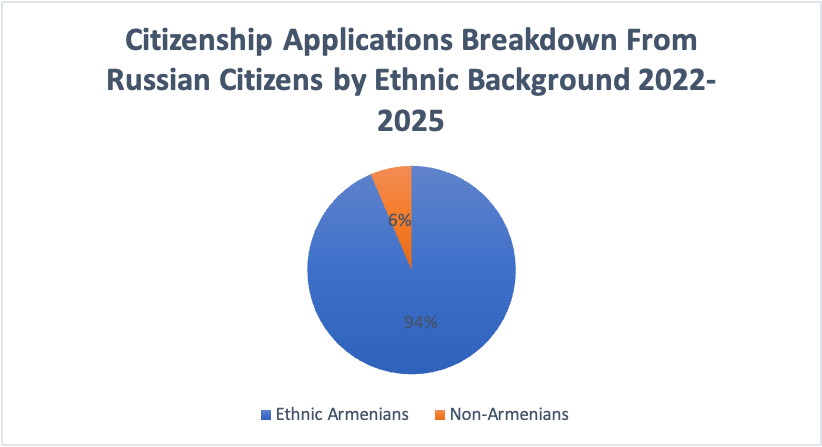
The lure of getting an Armenian passport has significantly increased since 2022, when Armenia became a top destination for tens of thousands of Russian citizens leaving the country. In an official response, the Migration and Citizenship Service of Armenia’s Ministry of Internal Affairs (MCS) confirmed that the number of applications has sharply increased in the last three years, driven by the conflict. According to official data, 47,408 Russian citizens have applied for Armenian citizenship since 2022, and 45,306 of them have been granted it. The vast majority of the applicants, 44,365 people, are of Armenian descent, qualifying them for a simplified procedure.
Why Armenia?
A report by the International Organization for Migration (IOM) identified three waves of Russian migration to Armenia: those who arrived shortly after the war began for work or political views, their families who followed, and a third wave of those fleeing Russia’s partial mobilization in late 2022 to avoid conscription.
Armenia became a preferred destination for several reasons. Russian citizens do not need an international passport and direct flights with Armenia are available. Russian is widely used and understood in Armenia, eliminating the language barrier. A third reason, according to IOM report, is the “absence of negative attitudes or discriminatory behavior” towards Russians in Armenia.
Fast-Track for Ethnic Armenians
Almost 94% of the citizenship applications from Russian citizens since 2022 came from people of Armenian descent. This is the most straightforward path of getting citizenship, as the requirements of three-year residency and knowledge of the Armenian language and Constitution do not apply. This path is also available to spouses of Armenian citizens, children of former Armenian citizens, people who renounced citizenship after 1995 and to individuals recognized for their “exceptional services.”
According to Airiianc, the process for people with Armenian descent is quite easy, especially now with the electronic registration system. But back in 2022, when Airiianc started the process, the system was not yet operational and she faced chaotic queues.
“People would come at 4 or 5 a.m. in the morning to get appointment,” Airiianc said.
But her biggest challenge was proving her descent. Born in Baku, she had lost her original birth certificate and a duplicate issued by Armenian consulate in 1991 was also lost.
“I spent two and a half months chasing the document in archives, email, the consulate, anywhere,” she said. “They refused to issue another, and my only option was to go to court.”
It seemed hopeless, until one day her friend who had keys to her Russian apartment found the duplicate inside a book. Afterwards, the procedure went smoothly. She applied on Sept. 1, 2022 and was granted citizenship by a presidential decree in February, 2023.
“I was very emotional,” Airiianc said. “My hands were shaking and I thought of all my ancestors- survivors of the Armenian Genocide, Soviet repressions, and Sumgait pogroms…getting Armenian citizenship was the least I could do in memory of them.”
Longer Path for Russian Citizens Without Armenian Roots
For a small minority of Russian citizens, without Armenian descent or ties to Armenian nationals, the path to citizenship is longer. According to the Law, the applicants must have legally resided in Armenia for the preceding three years, be able to explain themselves in Armenian and be familiar with the Constitution. When the application is accepted by the MCS, it is then reviewed by the National Security Service of Armenia.
The exact number of applicants on this path is unknown since MCS does not keep separate statistics on the legal grounds for obtaining citizenship. But the available data suggests the numbers are expected to be low- for example, only about 1,000 short-term residence permits were issued annually since 2022. While this does not count for long-term permits or other legal pathways for residency, it indicates the overall number of applicants is limited.
Those who arrived in 2022 are just becoming eligible to apply.
Sukhoroslov moved to Armenia in 2022 and immediately applied for a short-term residence permit. Just over three years later, on April 21, 2025, he and his girlfriend applied for citizenship. (Later, Sukhoroslov said that their applications were denied).
He has been meticulously documenting challenges and sharing them in a Telegram channel he runs, a community of around 700 Russians considering citizenship.
The first challenge Sukhoroslov noted was finding the full list of required documents. While the full list is hanging on the wall at the Davtashen Department of MCS, the online version differs and lacks details, especially regarding the basis of application.
Booking a consultation is nearly impossible, with slots on the EarlyOne app filled months in advance and registration on migration.e-gov.am unavailable since last year.
Even appointment slots for submitting documents are full. The MCS stated that the large influx of applications has increased the workload for the service and advised to wait for the updates when the new digital system starts operating on Jan. 1, 2026.
Sukhoroslov also stressed a common misconception among Russians. “They live here on visa-runs by leaving for Georgia once in six months,” he said. “But this does not count as uninterrupted residency for citizenship purposes.”
The language requirement poses another challenge. The applicant is considered “to be able to explain himself/herself in Armenian”, if they personally fill out the application-questionnaire and answer more than half of questions on Constitution.
“Many people assumed that knowledge of Armenian will be checked at the level of memorizing the questionnaire and writing their name,” Sukhoroslov said.
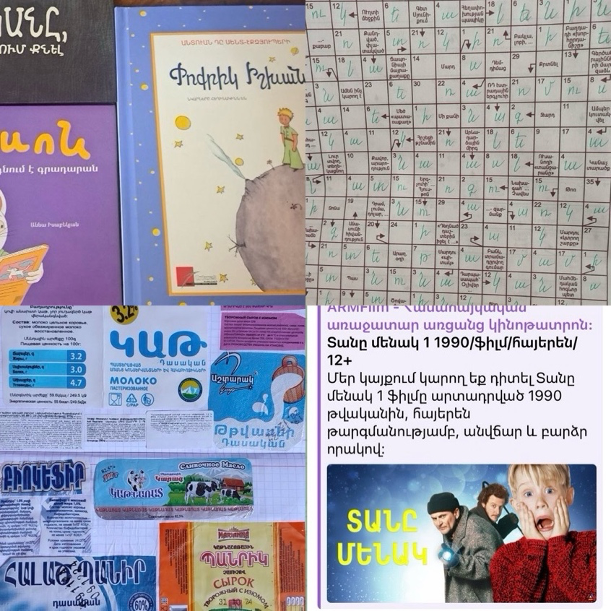
“But when we started having people apply, we realized you are expected to actually communicate with them in Armenian.” The fear of failure has made some delay their application, according to him, further decreasing already small number of applicants by residence.
Alexey Isupov, 40, who moved to Armenia in 2023 takes two Armenian classes per week but admitted it is not enough.
“I also try to study by myself,” he said. “I can read simple texts, but need a dictionary for harder ones. Also, Armenian letters such as ‘ց’, ‘ծ’, ‘ձ’ and ‘հ’, ‘խ’, ‘ղ’ are still confusing.”
Sukhoroslov, who began learning Armenian right after arriving, also noted problems with practice. “Most Armenians immediately start talking with us in Russian even when we try to speak Armenian.”
According to MCS updates on language testing process next year will be clarified once the government adopts a relevant decision.
Meanwhile, the uncertainty is taking emotional toll. Sukhoroslov is aware of 20 people who applied in 2025, when those who arrived in 2022 became eligible. Of these 20, six were rejected, one was approved and the rest are still waiting for a decision.* According to Armenian law, “the rejection decision may not be justified,” adding up to uncertainty. Several others in his community are still waiting for a decision.
Isupov, who will be eligible to apply after May 2026, remains hopeful, but uneasy. He feels deeply grateful to Armenia for giving him “the best job of his life” as he felt “very, very bad psychologically” in Russia and found immediate relief upon arrival here. Yet, even now it feels like he is “at a crossroads.”
“At one moment I imagine that I might get citizenship and buy real estate,” Isupov said. “At another, I don’t know what will happen next and whether I will have to leave against my will.”
*Editor’s note: Sukhoroslov provided this information after the article was published, on Feb. 1, 2026.