

The Terracotta Center’s new public art installation seems small at first — tucked away at the entrance to the English Park. On a snowy winter day, the site is quiet and secluded, not exactly what you might expect for an art installation.
The location itself has previously been home to less impressive street art (and some still remain around the park), and the modest first impression raises questions about whether the installation would be forgotten after a couple of hours of seeing it.
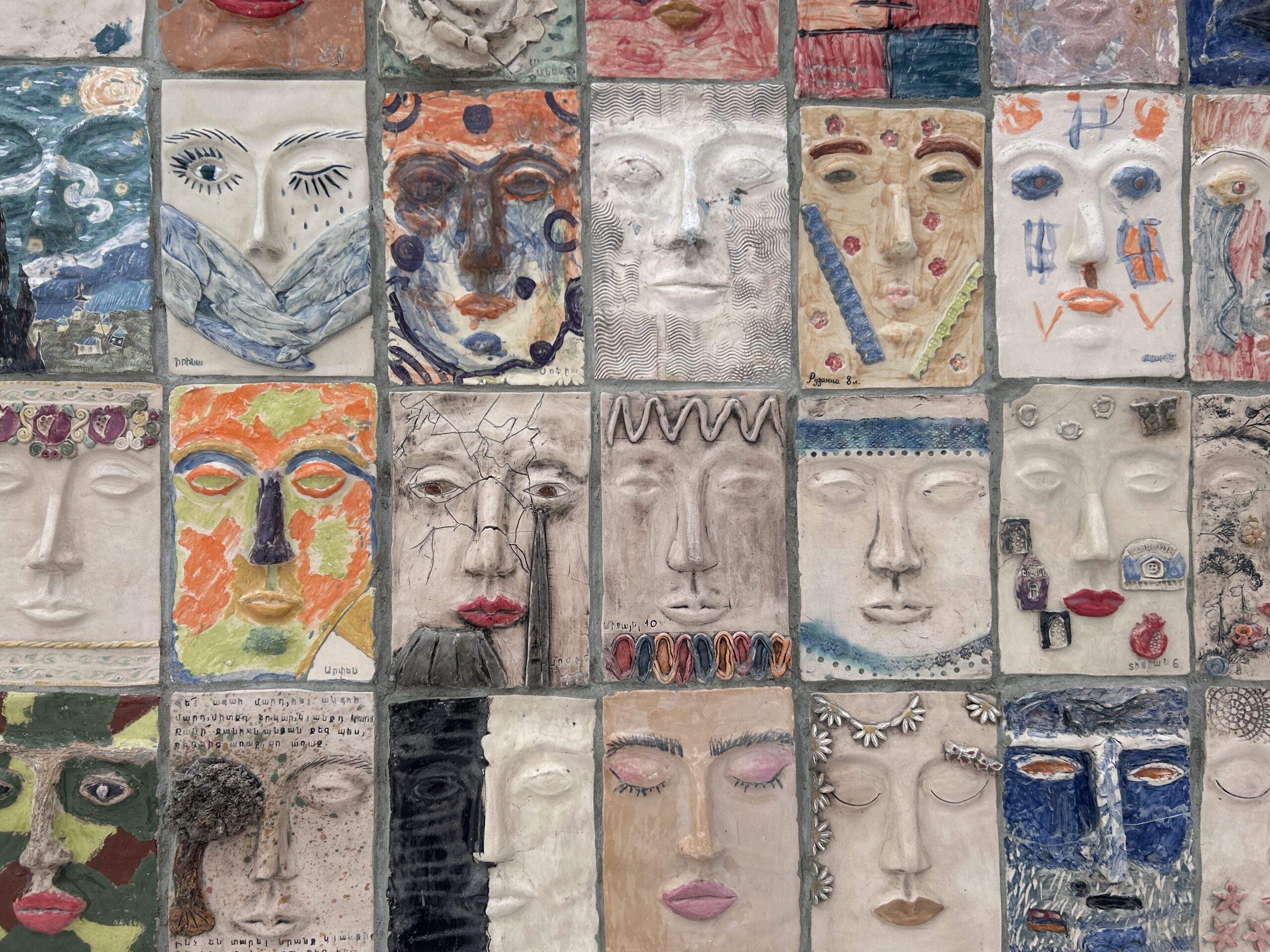
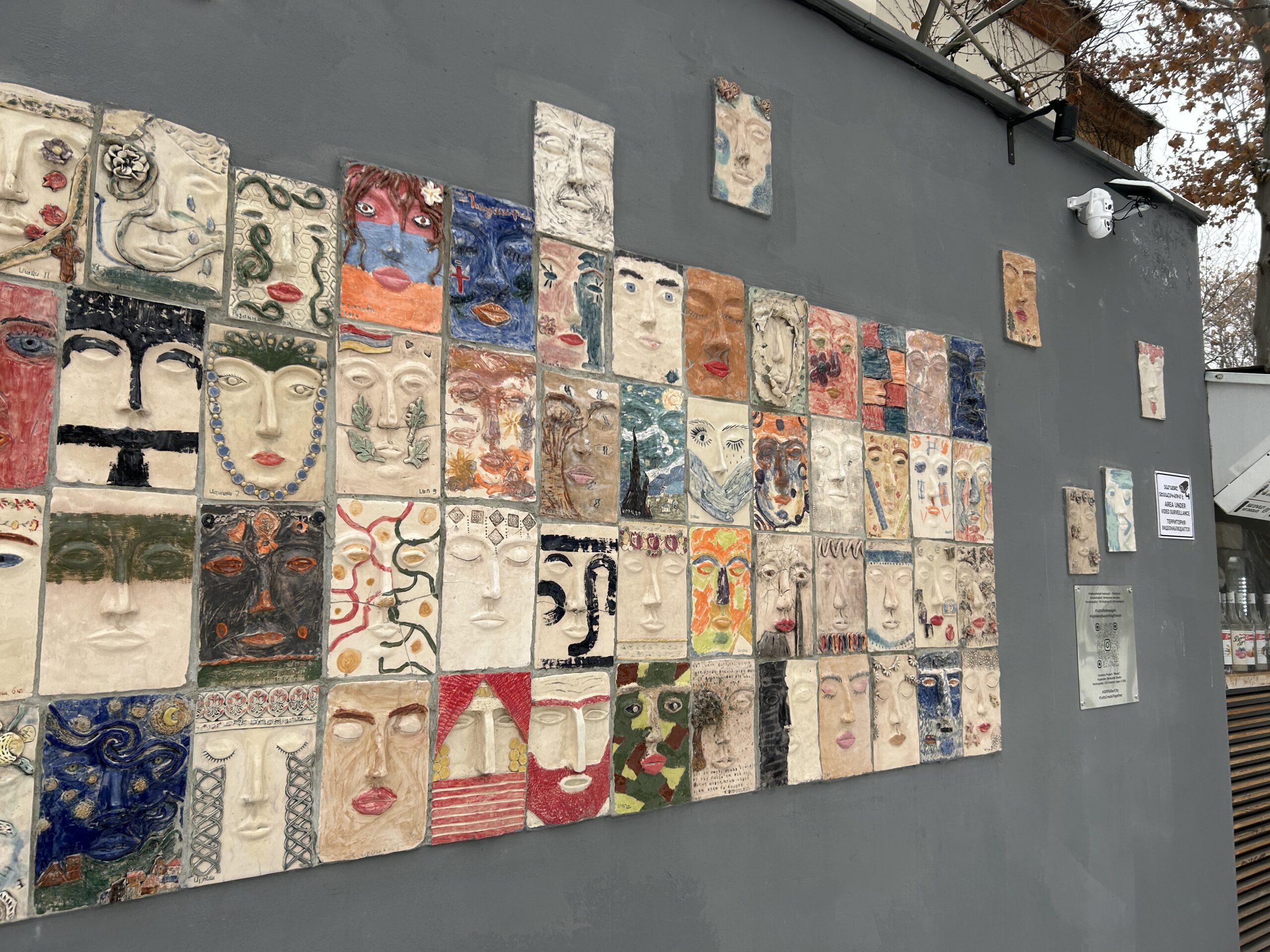
But closer inspection changes that perception. What Nana Manucharian, the founder-director, and the Terracotta Center have created is something warm and kind. The installation is a massive archway composed of more than 150 handmade ceramic mask tiles, each crafted by participants ranging from age zero to 100.
The phrase that kept surfacing, including from Manucharian herself, was nver mer qaghaqin (a gift to our city), which is a sweet sentiment, as more than 150 people took their time and creativity to make a shared public space more beautiful.
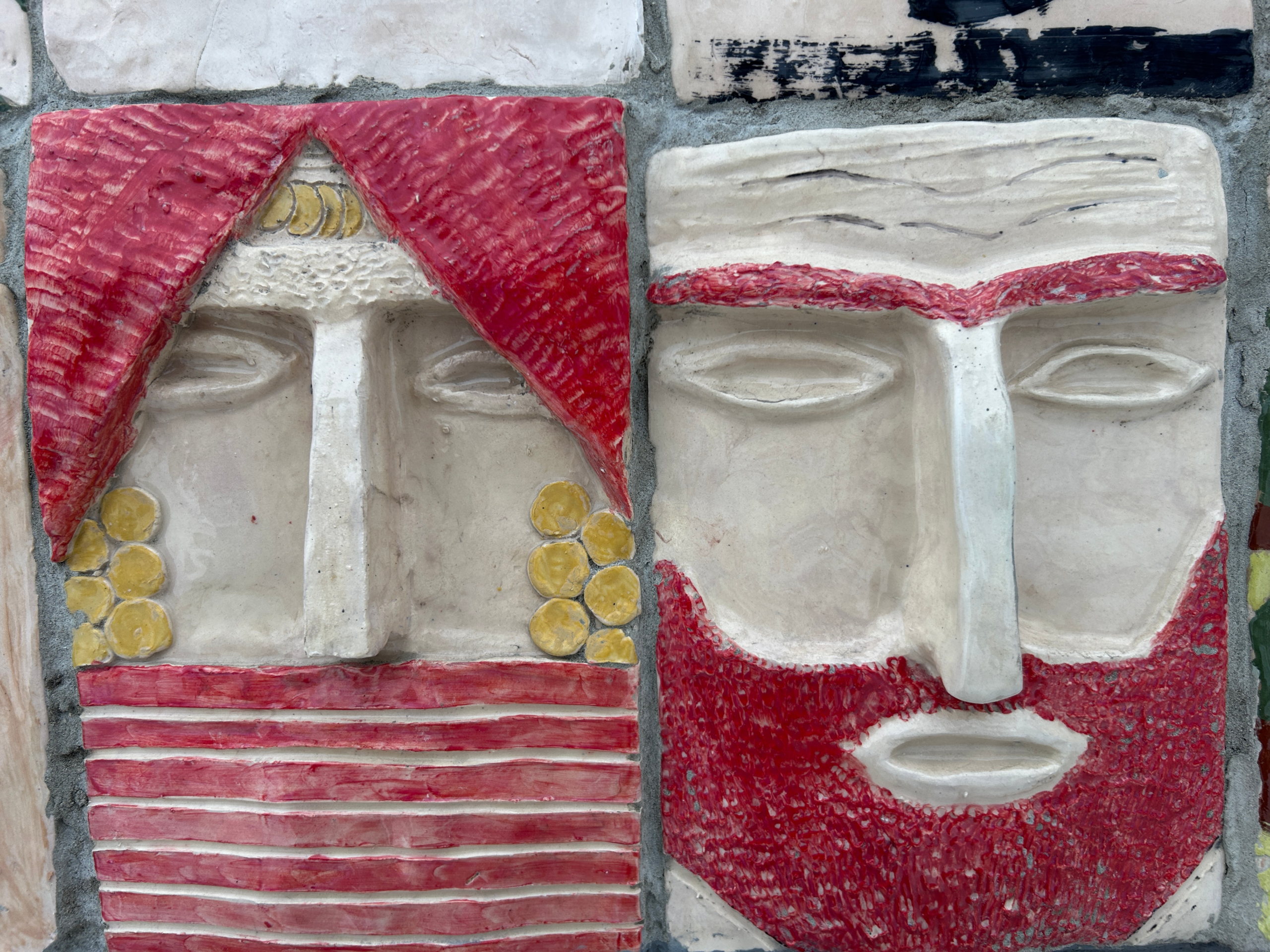
According to Manucharian, the mask project was born in the aftermath of the 2020 Nagorno-Karabakh War, and Artsakh-themed masks were predominant. Another theme is individualism.
“Every person is an individual and one of a kind,” Manucharian said. “Despite using the same plaster mold, no two masks are alike.”
The project took nearly two years to complete. “We worked on the project for about two years. We couldn’t get permission from the Municipality of Yerevan for a long time to gift the work to the city,” Manucharian said. The final installation involved children and adults, along with Terracotta Studio teachers Hasmik, Alyona, Nune and Alexey.
The center has been running diverse art projects for 16 years and, according to Manucharian, whenever a new project is announced, everyone is involved, whether that be a master or a student.
“This is how it’s done in our studio: Everyone who visits our studio participates — including the little ones and the adults,” Manucharian said. “Everyone approaches the project with enthusiasm, as our masters and teachers inspire visitors, regardless of whether the visitor is experienced or a beginner.” This is visible on the installation as well, as the hand of a 5-year-old sits next to that of an experienced artist, both contributions sharing equal space on the wall.
The installation is beside the Park gates, stretching wide along a freshly painted wall. Around 150 ceramic masks are densely packed together, with slight gaps between them, held together with cement.
The placement at the English Park entrance is deliberate. “We didn’t choose the location for the masks randomly,” Manucharian said. “The English Park is where Sundukyan Theater is located — and the mask is also a symbol of theater.” According to her, the studio places great importance on developing decorative applied arts.
At first glance, the color palette seems muted, with white and cream dominating the surface. But up close, peach tones, deep blues and purples emerge. Some designs are straightforward and realistic, which creates an “uncanny valley” effect. Some have a more surreal look, such as eyes with darker irises and unnatural skin colors.
The installation is meant to be touched. Running hands over the cool, smooth, glassy surfaces reveals three-dimensional elements: protruding noses, sculpted eyes — some open, some closed — and decorative objects that give each face depth and presence. Some are so realistic that touching them feels unsettling, as if making contact with an actual person.
One of the most delicate pieces is a pale mask overlaid with a lace pattern, as if the piece of fabric has been gently pressed into the clay. The lacy pattern is brown, matching the paleness of the face. The eyes have no irises, giving the mask a ghostly look, as if frozen in time. Floral motifs run across the forehead and cheeks, framing the closed eyes like a veil. There is a fine crack across the surface, which makes the face look more fragile and slightly ceremonial —like a bride.
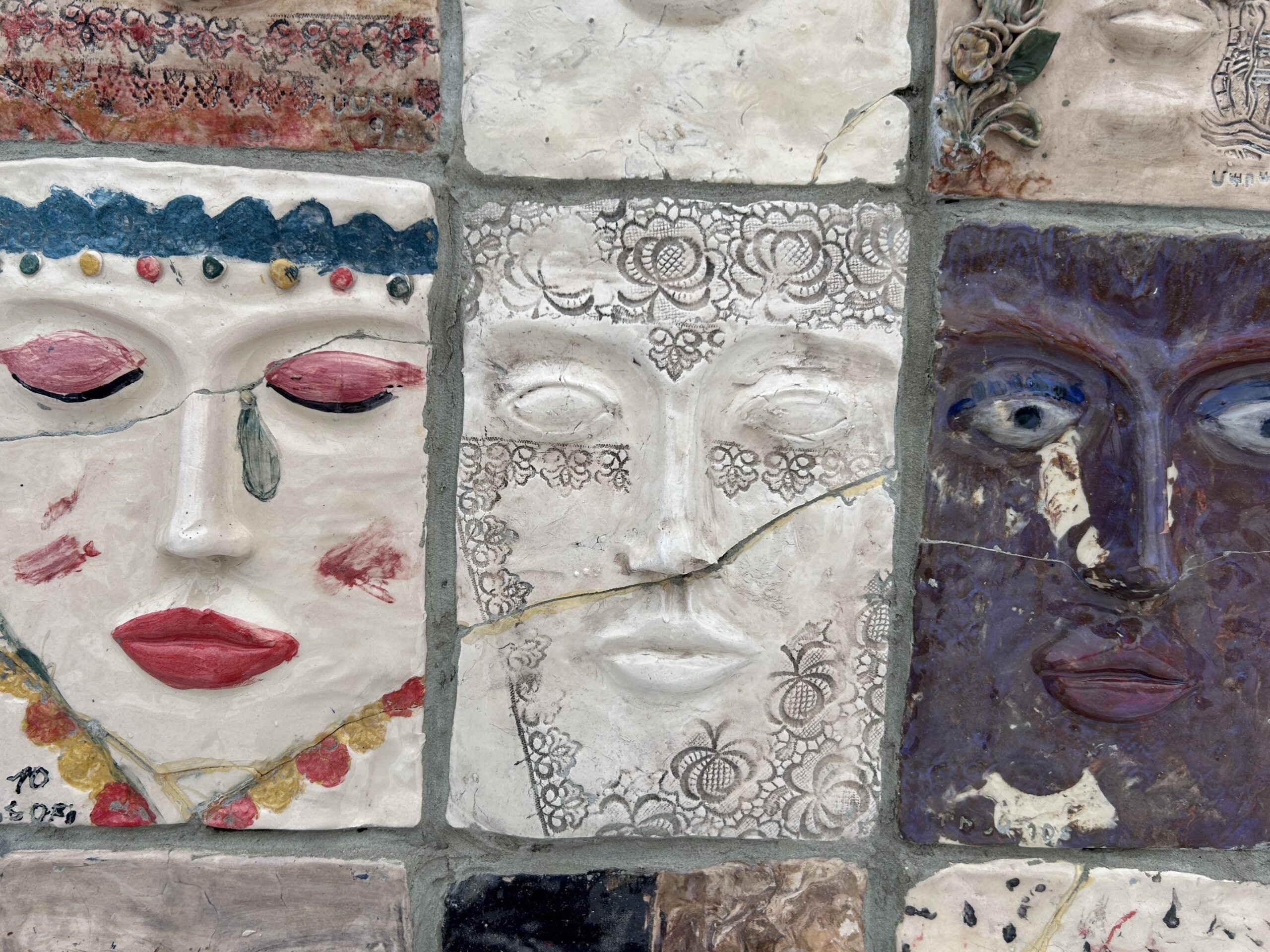
Another standout piece is a mask crossed by abstract, almost calligraphic lines, reminiscent of Bauhaus designs in muted blues, purples and black. The face is calm, with slight eyeliner and softly molded features. Aside from the lines, the surface is decorated with layered brush strokes. Unlike the lace mask, which evokes tradition, memory and delicacy, this one feels modern and introspective, as if the emotions and thoughts of the person are written directly onto the skin.
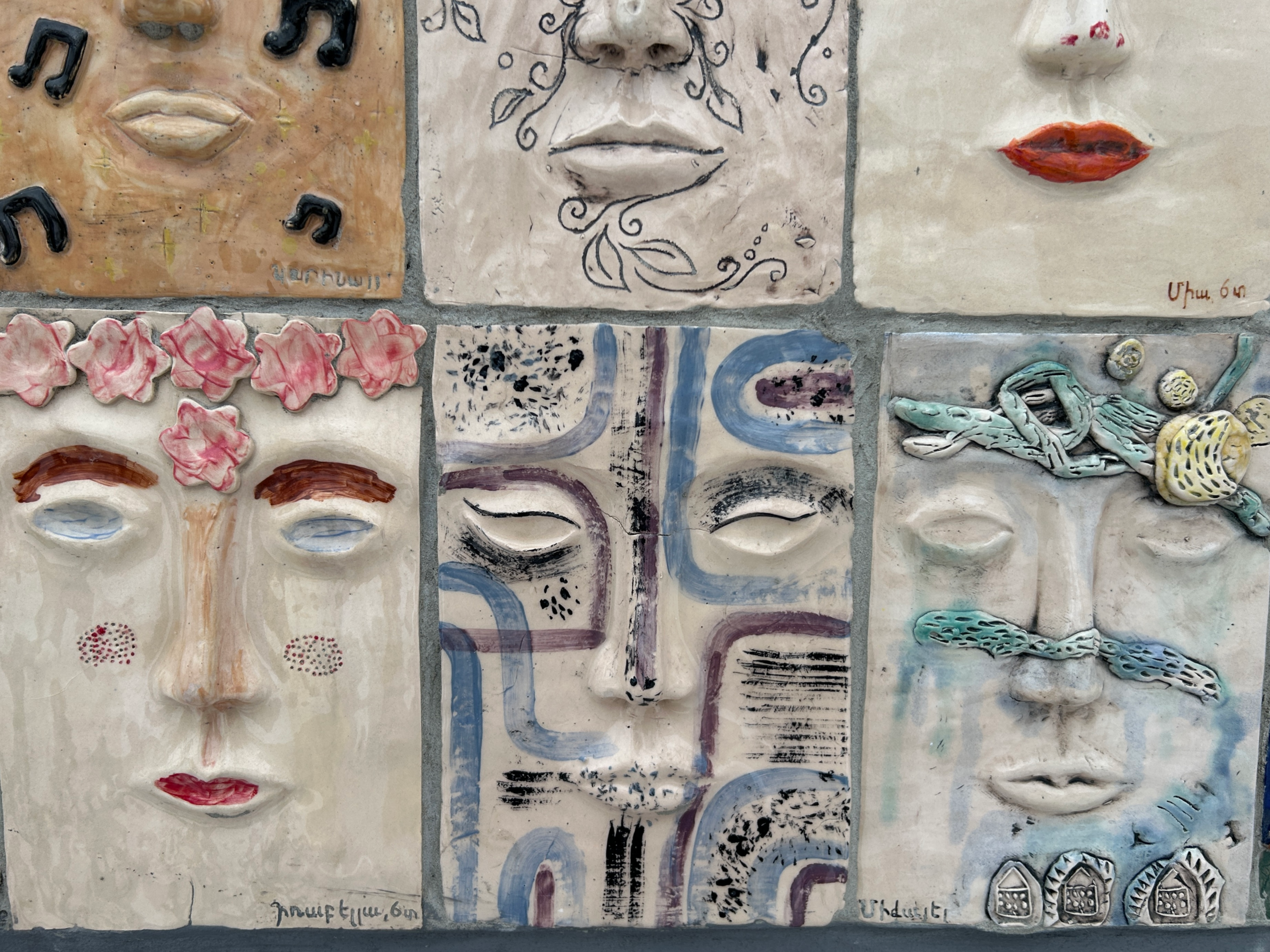
Qnarik Grigoryan, 28, is a mother of Leo, now 5, who at the age of 4 joined the project as well.
“I am very proud and happy that at that age, thanks to Nana, an opportunity was given to him to participate in such a project,” Grigoryan said.
She emphasized the importance of art in Yerevan: “The project beautifully characterizes Armenians and Armenia’s spirit. I’m happy that there is such a work of art at the heart of Yerevan,” she said. “Nana also has a very important role in spreading art and educating generations.”
Some other recurring themes emerging include Van Gogh-inspired swirls, including direct homages to “Starry Night,” floral decorations, lace prints, and traditional Armenian motifs.
Still, there’s something intimate about the hidden quality of the placement, like randomly stumbling upon it on a street, and it makes the day more memorable.
Manucharian is direct about the role of street art in urban life. “Street art is an important concept for cities because art in general is the face of the city,” she said, explaining that the conversation can be about any form of art — architecture, sculptures, frescoes that decorate the walls both outside and inside, and ceramic panels, which is what the studio works on.
According to her, art is essential to a city’s identity. She posed a question about why people travel and what draws them to different cities, answering that what people ultimately seek is art.
Manucharian also spoke about the lack of institutional support. “Unfortunately, our state doesn’t realize it,” she said, referring to the importance of art in the city, adding that the studio fully relies on its resources when doing a project.
Yet, Manucharian sees progress among the population and notices how people are much more open to art now. “When we were first doing our first projects, our big fear was that people would ruin them or wouldn’t understand,” she said.
She plans to continue. “Just as we have started, we will continue such projects and hope that through such projects, the city will take a more unified appearance.”
[Editor’s note: Photographs are taken by the author.]