

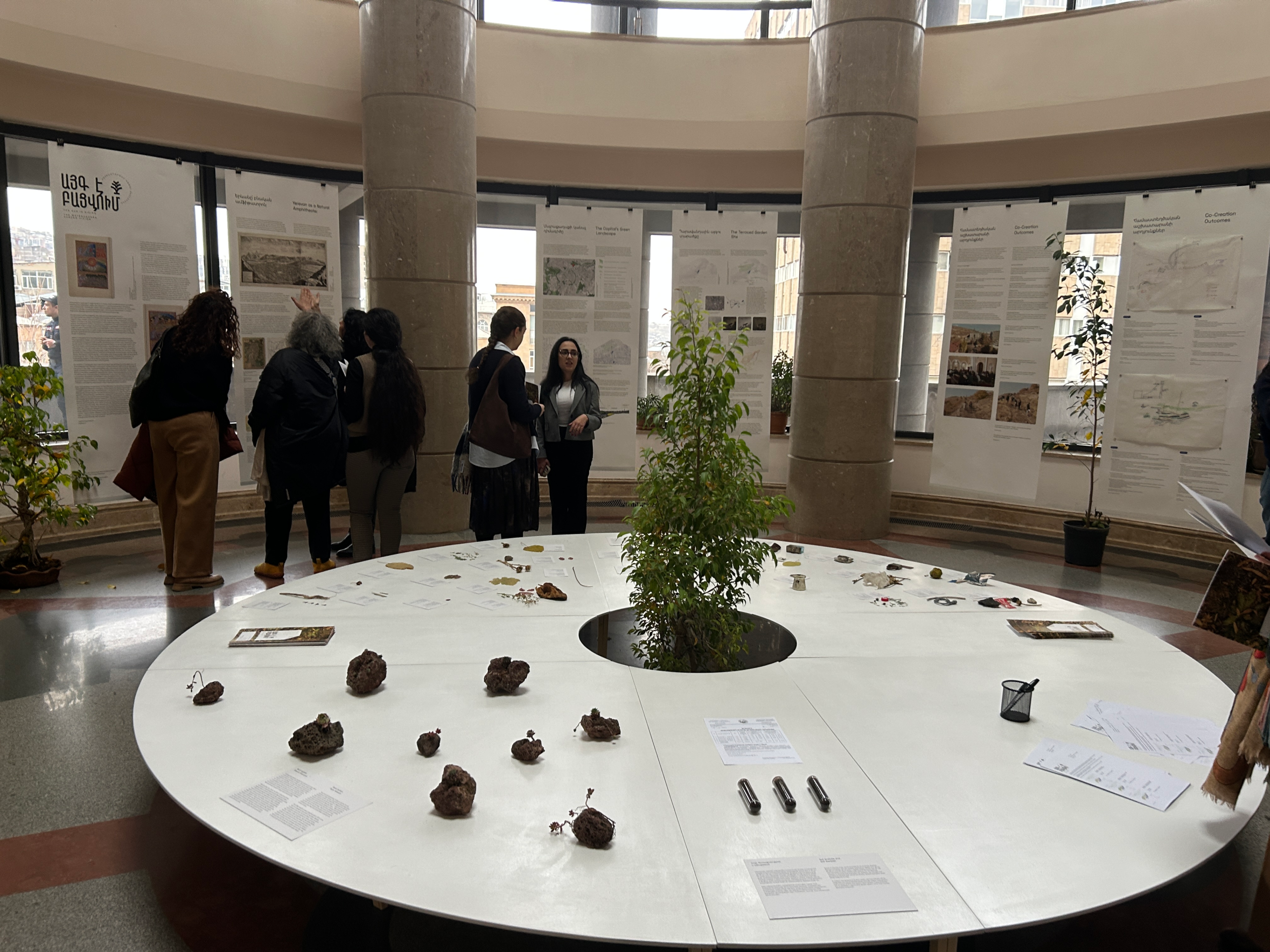
“Polluted air — that’s what the garden creation should be fighting against,” is a quote belonging to Karlen Madoyan, one of the 40 interdisciplinary specialists who developed the future vision of the Matenadaran garden. The quote became the main poster for the “Sun Is Rising” exhibition which presents visions by artists, curators, architects, urban planning specialists, Matenadaran researchers and others.
The project is a collaboration between Matenadaran, Armenian Tree Project (ATP) and AHA Collective focusing on landscape, cultural identity and the garden as an expression of its users’ lifestyle and thought. The proposal connects environmental restoration with urban development, preserving Yerevan’s landscape and incorporating the new garden design into the city structure.
During the curator’s tour on Feb. 14, the AHA Collective Director Nairi Khachadourian discussed the co-creation process behind the project.
“The first phase of designing the Matenadaran garden was to approach it in a much more inclusive way,” she said. “Citizen participation and the involvement of various specialists have been incorporated into urban planning methodology.”
The exhibition includes references to early depictions of Yerevan, its landscape, city views and gardens. As Khachadourian noted, green space has long been essential to the city, particularly within Yerevan’s terraced structure.
“Armenian topography is terraced in nature,” said Arusyak Hovhannisyan, assistant to the curator. “Architects also describe Yerevan as an amphitheater surrounded by mountains and hills, and those hills are themselves terraced.” She emphasized the importance of geography and preserving the character of the area while shaping the approach.
The process began on Nov. 22, 2025, when the workshop was organized, allowing specialists to express their views and visions for the future of the garden.
The participants had a chance to experience the area themselves by walking, climbing and “reading the site,” collecting items into envelopes that currently shape the ecology of the area. This documentation became an art installation — 38 samples form the “Flora and Material Library” exhibited in the Academic Building of Matenadaran alongside garden visions. The library is located at the center of the exhibition and includes tin cans, coffee makers, plastic, perfume bottles, paper, etc. Plant samples found in the area are displayed nearby to emphasize floral diversity.
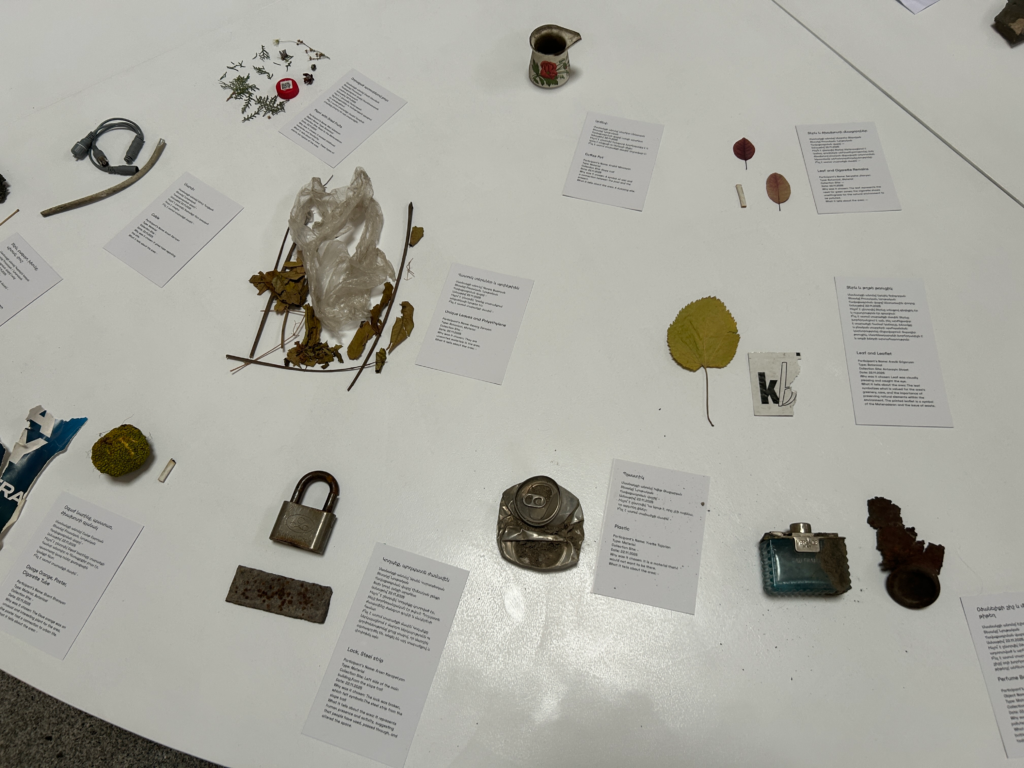
Hovhannisyan said that they focused on biodiversity; in almost all projects presented within the co-creation workshop, the species of trees or specific architectural pathways were proposed to improve access and environment for the animals.
The director of AHA Collective and the assistant said the project highlights the importance of the garden and Armenia’s biodiversity ahead of the upcoming COP17 conference.
“After exploring the terrain and viewpoints, we worked with the Armenian Tree Project to study plant species suitable for the site,” Khachadourian said. As a result, six conceptual maps were created, representing different approaches.
“Some emphasized organic design aligned with the terrain,” she said. “Others proposed tunnels and elevators for people and wildlife, including connections toward Victory Park. Another concept focused on a structured vineyard garden reflecting Armenian cultural identity.”
The concepts suggest dense tree planting along Saralanj Street to reduce noise and dust. Educational zones could present plant species used historically in manuscripts for dyes, waxes and balsams, enriching visitors’ museum experience and supporting Matenadaran’s research — emphasizing the biodiversity and educational value of the garden.
Irem Ani Kchayan, a visitor of the exhibition, is a sophomore at the Architecture Department of the National University of Architecture and Construction of Armenia. She said “this is an exceptional public space, a green area that won’t harm the city.”
“Overall, I think the idea is wonderful, because Yerevan has a significant shortage of public spaces and green areas,” Kchayan said .
According to her, it is very reasonable to give the public a choice, because if society is involved in the design process, it will approach the preservation of the project with greater care after its realization. “Society may begin to feel closer to this important structure and value it more than it does now,” Kchayan concluded.
The exhibition is open from Feb. 6 to March 6 allowing visitors to learn about the proposals and select one of the three final recommendations that include Armenian Orchard (terraced area with circulation paths, stairs, planted areas, water fountains, cafes, benches), an Urban Vineyard Garden (a structured vineyard with circulation and seating areas) and Garden of Contemplation (an open space for reflection, water features and quiet zones for the Matenadaran researchers and Yerevan residents).
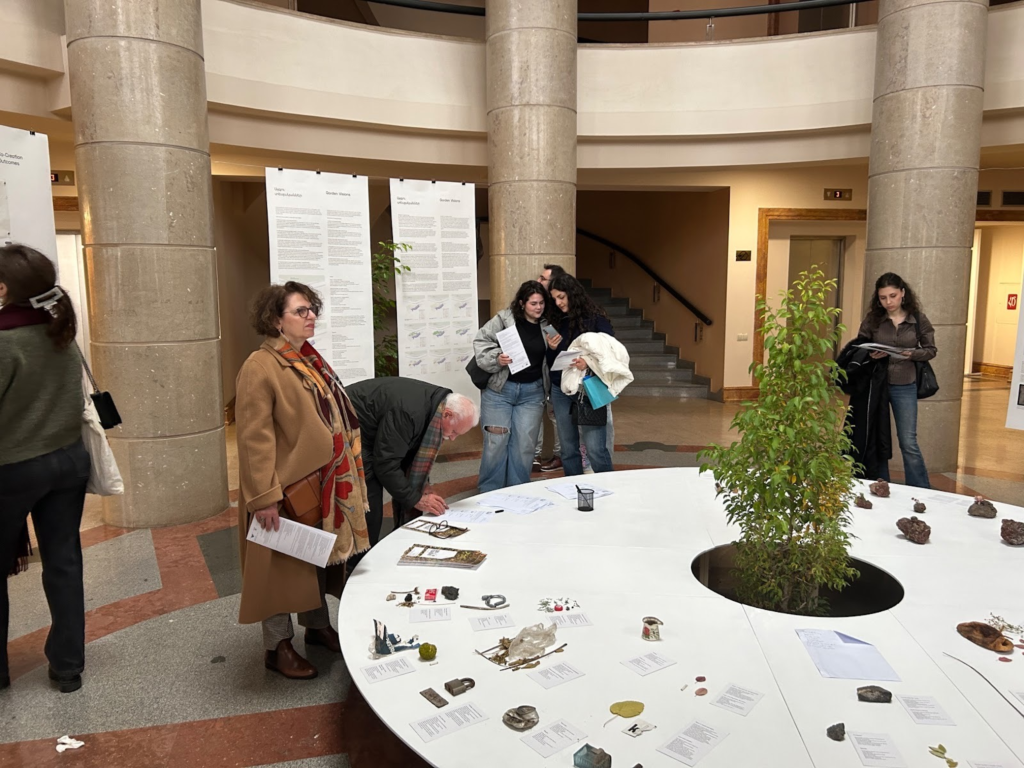
The garden also proposes a “Circular Care” approach which would involve schoolchildren collecting seeds from plants grown in the garden, replanting them in ATP nurseries and using them in future projects across Armenia.
According to Hovhannisyan, following this exhibition and the co-creation workshop phase, the actual design work for the garden will begin ahead of COP17.
[Editor’s Note: The photographs are taken by the author]