

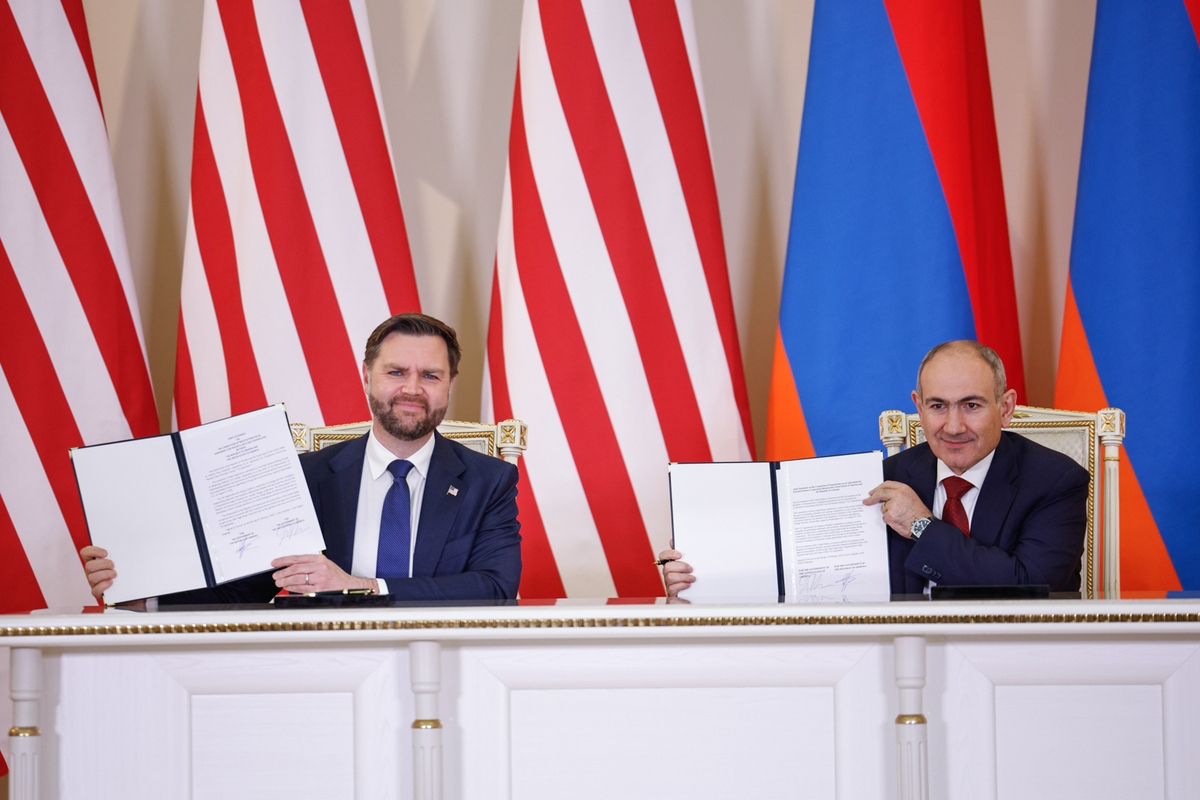
On Feb. 9-10 , 2026, U.S. Vice President J.D. Vance made an official visit to Yerevan, becoming the highest-ranking American official ever to visit Armenia. The trip followed more than a year of steadily deepening ties between the two countries and marked a transition from high-level political rhetoric to sector-by-sector cooperation.
The visit was described by both governments as a turning point. “What is happening here today is historic,” Vance said during a joint appearance with Prime Minister Nikol Pashinyan, emphasizing that the United States and Armenia were entering “a new chapter” of partnership. Pashinyan, in turn, said bilateral relations were now “at their highest point,” while adding that the real work was just beginning.
The foundation for this moment was laid in January 2025, when Armenia and the United States signed a Strategic Partnership Charter. That document outlined cooperation in security, democracy, economic development and regional stability. It did not contain specific financial commitments, but it signaled a recalibration of relations at a time when Armenia was reassessing its foreign policy orientation and security model.
The next major step came on Aug. 8, 2025, in Washington, where the two governments signed three memoranda of understanding. These memoranda were not binding treaties and explicitly stated that they did not create legal or financial obligations. However, they translated political intent into structured areas of cooperation.
One memorandum focused on infrastructure and border security under the “Crossroads of Peace” framework. It addressed modernization of customs systems, strengthening of border control capacity, cybersecurity cooperation and technical exchanges between U.S. agencies and Armenian institutions. It also reaffirmed U.S. support for Armenia’s sovereignty and internationally recognized borders. In practical terms, it positioned Armenia as a potential transit hub in a region where transport connectivity remains politically sensitive.
A second memorandum addressed artificial intelligence and semiconductor innovation. It aimed to develop Armenia’s semiconductor ecosystem, strengthen export controls, encourage private investment and promote joint academic and research partnerships. The document framed Armenia not only as a security partner but as a participant in secure technology supply chains at a time when global competition over critical technologies has intensified.
The third memorandum established an Energy Security Partnership. It explicitly referenced civilian nuclear cooperation, including small modular reactor technologies and outlined goals such as diversifying Armenia’s energy sources, modernizing infrastructure, strengthening resilience of critical energy assets, and encouraging private sector investment. This was the first official bilateral document to formally mention potential cooperation on small modular reactors.
Energy diversification is not an abstract issue for Armenia. The country’s Metsamor Nuclear Power Plant supplies more than 40% of Armenia’s electricity. Built in the Soviet era, the plant operates under an extension that runs until 2036. Armenia relies heavily on imported natural gas, most of which comes from Russia, to fuel thermal power generation. While electricity production is domestic, parts of the energy infrastructure and supply chains remain closely linked to Russian companies. Against this backdrop, discussions about new nuclear capacity are tied to long-term questions of energy security, diversification and strategic autonomy.
During Vance’s February visit, the two sides announced the completion of negotiations on an agreement on the peaceful use of nuclear energy, commonly referred to as a “123 Agreement” under U.S. law. Such an agreement is required before American companies can export nuclear technology, fuel or services to another country. Vance stated that the framework could enable phased cooperation valued at up to $9 billion, including approximately $5 billion in American exports of technology and equipment and up to $4 billion in long-term fuel supply and technical support contracts. Armenian officials stressed that this figure reflects the potential scale of commercial cooperation rather than a direct grant from Washington.
The announcement was accompanied by other concrete steps. Vance confirmed the approval of roughly $11 million worth of American-made reconnaissance drones for Armenia, marking the first major U.S. military technology sale to the country. Discussions also touched on cooperation in critical minerals and advanced computing technologies. After completing his meetings in Yerevan, Vance traveled to Baku, underscoring Washington’s parallel engagement with both Armenia and Azerbaijan as it seeks to remain an active player in the South Caucasus.
The regional dimension adds another layer to the visit’s significance. Infrastructure discussions, including the Trump Route for International Peace and Prosperity transport corridor initiative and the broader “Crossroads of Peace” concept intersect with sensitive geopolitical questions. U.S. involvement in regional connectivity projects, as well as in Armenia’s energy and technology sectors, signals a deeper American footprint in a region traditionally shaped by Russian influence. At the same time, Washington’s outreach to Baku reflects an attempt to balance relationships rather than align exclusively with one side.
The timing of the visit also matters. The South Caucasus is undergoing a period of diplomatic recalibration following years of conflict and shifting alliances. Armenia is exploring new economic and security partnerships, while the United States is seeking to expand its role in Eurasian connectivity and energy transitions. In this context, the January charter, the August memoranda and the February nuclear framework form a coherent sequence rather than isolated events.The memoranda themselves remain non-binding, and Armenia has not yet selected a final partner for the construction of a new nuclear facility. Officials have indicated that a definitive decision on reactor technology may not be made before 2027. In this context, Vance’s visit highlighted developments that had been set in motion earlier, particularly through the agreements reached between the two countries in 2025.