

AI is no longer just a buzzword in Armenia, it is becoming a field of growing public and professional attention. This was evident at AI Conf 2026, the country’s leading artificial intelligence conference, which opened at Yerevan State University on April 18. Within minutes of registration, it was clear that the event would surpass the Grand Hall’s 600-seat capacity. By the time the conference began, the hall was packed, with attendees standing along the walls and in the doorways.
This year, Yerevan State University (YSU), Krisp, the Union of Advanced Technology Enterprises (UATE) and the YerevaNN Scientific Educational Foundation organized the conference’s fourth edition.
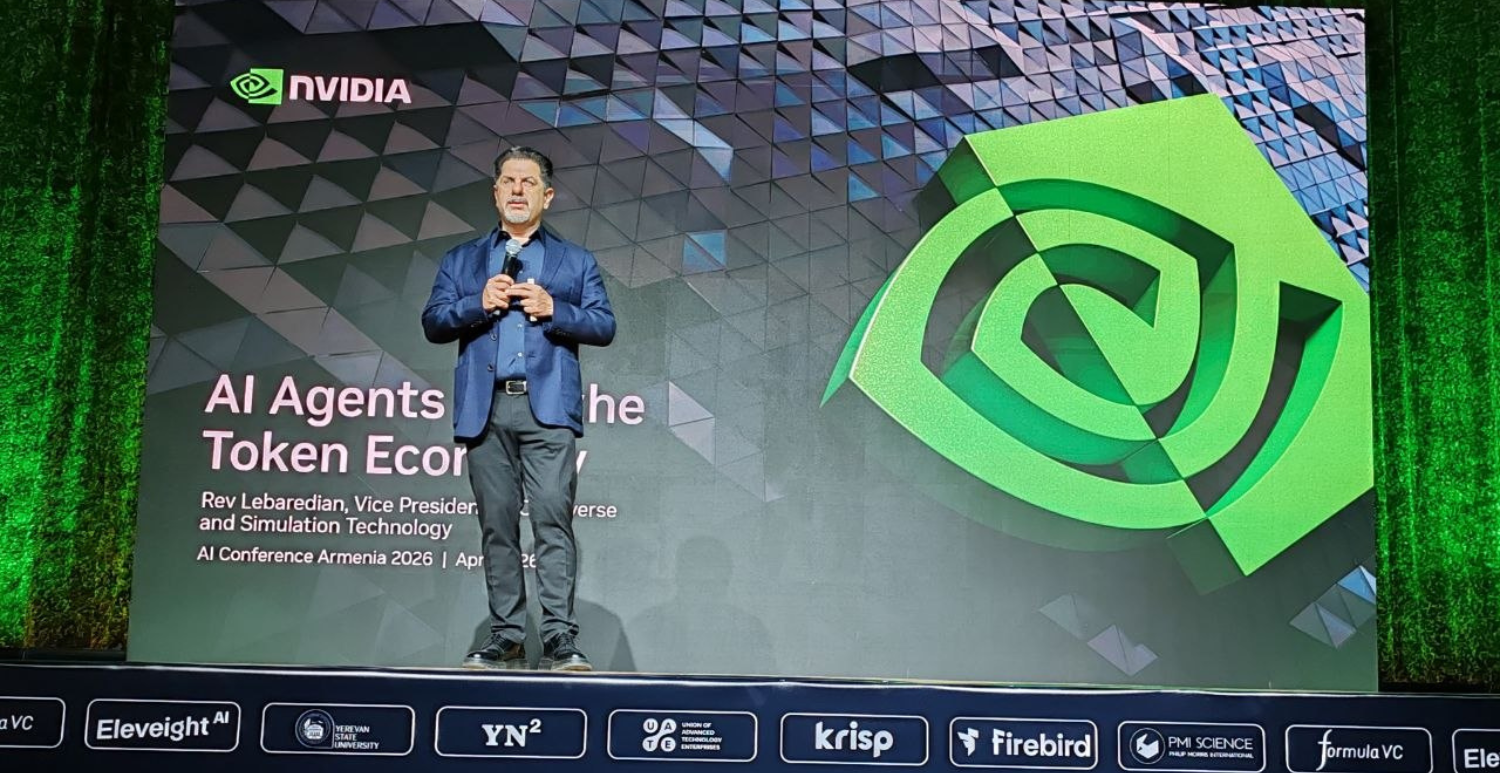
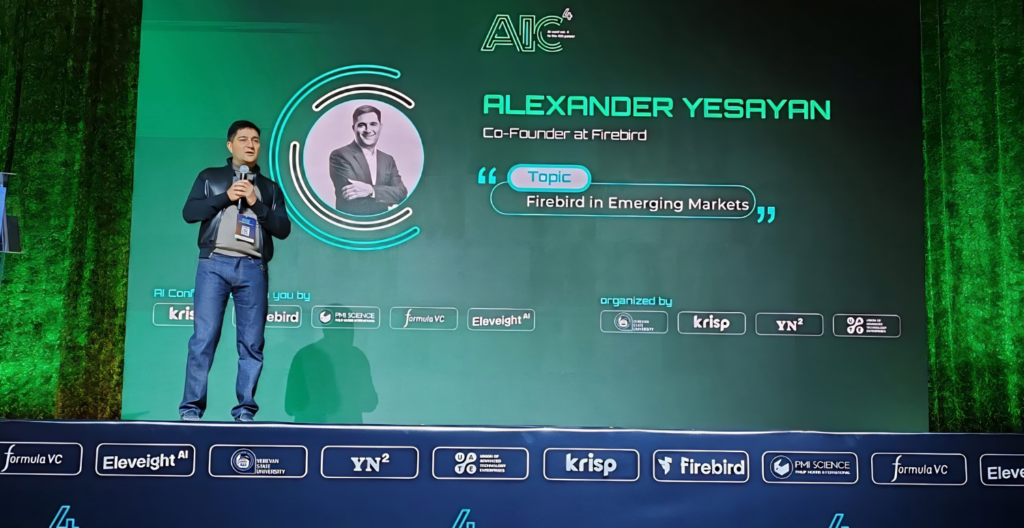
Much of the day’s program featured panels from scientific groups and industry leaders at institutions like the American University of Armenia, National Polytechnic University of Armenia, Eleveight AI, Krisp, and YerevaNN, where researchers and specialists discussed their latest projects to attract prospective students and talent. Yet it was the high-profile announcements from Alexander Yesayan, Co-Founder of Firebird, and Rev Lebaredian, vice president of Omniverse and Simulation Technology at NVIDIA, that truly grabbed the spotlight.

AI-First Armenia
Armenia will emerge among the world’s top five countries by total capacity of graphics processing units (GPU), with an estimated 110,000 units deployed upon completion of the Firebird AI Factory.
This statement by Rev Lebaredian, a key figure behind Armenia’s recent leaps in AI, captured the attention of the entire hall. His speech left attendees with the sense that a narrow window of opportunity had opened for Armenia to redefine its place in the world, as he recalled his first meeting in 2018 with Prime Minister Nikol Pashinyan and Hakob Arshakyan, who a year later would become Armenia’s first minister of high-tech industry.
“When I first met them, I told them that for Armenia to exist, to be viable, to be prosperous, the only chance we have is to capitalize on our only natural resource: our human brains,” said Lebaredian.
Economic capacity is no longer tied only to population size, but to how effectively a country can convert knowledge, energy and infrastructure into intelligence. For a country of three million, Lebaredian argued, artificial intelligence offers a way to compete globally, with digital agents functioning as additional “citizens” and expanding a country’s productive capacity beyond its demographic constraints.
“What’s happening is that very quickly we are going to see our IT departments essentially turn into HR departments. They’re going to become HR for our artificial employees,” he said.
Lebaredian said Armenia is already participating across what he called the “five-layer cake” of AI, from energy and chips to infrastructure, models and applications, positioning the country to play a role at every level of the emerging ecosystem.
“For this revolution, we don’t have to play catch-up. We can be the leaders,” said Lebaredian.
He described the current moment as a “great reset,” arguing that all countries are starting from the same level, as no one fully knows yet how to use this technology.
“This time around, with this technology revolution, Armenia is actually at the forefront,” he said. “We are positioned to capitalize on this in a way we never had before. It all starts with AI infrastructure.”
The Year of the AI Infrastructure Boom
Armenia started the year with a series of announcements, marking a shift from ambition to execution in AI infrastructure.
In January 2026, YSU inaugurated a new supercomputer center built around 64 NVIDIA H100 GPUs. In the same month, Eleveight AI announced the deployment of NVIDIA Blackwell B300 GPUs at its AI-focused data center in Armenia and the arrival of the first batch of high-performance AI hardware in March.
Above these efforts is the most ambitious layer: the Firebird AI Factory. In June 2025, Firebird, a San Francisco- and Yerevan-based AI cloud startup, announced a $500 million public-private partnership with the Armenian government, with support from NVIDIA, to build the largest AI factory in the Caucasus.
Scheduled to begin operations in 2026, the project is designed in stages, each larger than the last. The first phase, a 6,000-GPU cluster, is expected to go live in June. The second phase will expand that capacity to 50,000 GPUs, positioning Armenia among the world’s top five AI clusters, with about 80% of the capacity allocated to global partners and 20% reserved for Armenia.
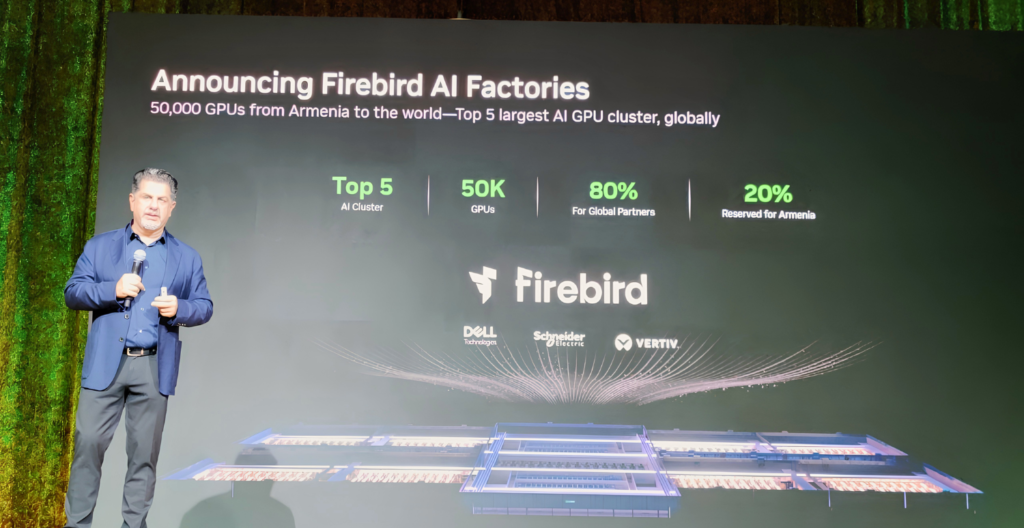
But even that, said Alexander Yesayan, is not the end point. The plan is to go further, adding another 60,000 GPUs in a third phase, bringing Armenia’s total compute capacity to 110,000 GPUs.
“Today we are among the first in the world by the number of GPU licenses we have secured,” he said.
The project did not begin at today’s scale. In 2024, Yesayan said, the plan was for a much smaller data center, with an investment of around $50 million. Even that was considered ambitious, but the effort stalled because there was no company ready to carry it through.
The turning point came a year later, when he began working with Armenian-American entrepreneur Razmig Hovaghimian. His deeper network in Silicon Valley and the U.S. technology sector helped bring together pieces that had so far remained disconnected.
“Our knowledge, Rev’s backing to secure NVIDIA GPUs, and Razmig Hovaghimian’s network, which allowed us to find customers: that combination is what made this possible,” said Yesayan.
Strategic Role of the State
To picture the scale, Lebaredian compared Armenia’s planned infrastructure with a recent announcement by Deutsche Telekom and NVIDIA, which are bringing online one of Germany’s largest AI supercomputers, powered by nearly 10,000 Blackwell GPUs.
“We are already at the same level as the largest economy in the EU, with just Phase 1 of Firebird,” he said.
Both Lebaredian and Yesayan pointed to the same factor behind that acceleration: the current U.S.-Armenia strategic relationship. Access to advanced GPUs, they said, is tightly controlled and Armenia’s ability to import them was not guaranteed.
“The United States government has given Armenia permission to import these GPUs,” Lebaredian said. “This is not something they give to everyone.”
At the same time, the Armenian government is beginning to play a more direct role in shaping how that infrastructure is used. The role of the state becomes more central as countries move toward what is increasingly described as sovereign AI, the ability to develop AI using their own infrastructure, data, workforce and business networks.
In April, the Ministry of High-Tech Industry signed a five-year agreement with Firebird AI, committing to purchase $25 million worth of computing resources to support local startups, research groups and universities.
The Human Bottleneck
It was not accidental that, after the opening keynotes, the rest of the conference, which ran until 7 p.m., shifted its focus to students and young talent.
The rapid development of AI infrastructure raised a more fundamental question: who will actually run and use these systems.
“We have to understand where the talent pool will come from,” said Armenian Code Academy co-founder and CEO Narek Aslikyan, whose organization regularly publishes reports on Armenia’s tech talent and sector. He believes that the country still does not have the conditions to produce thousands of well-trained young people each year with strong foundations in mathematics.
“This is something that needs to be addressed immediately, because the results will only come in 5 to 10 years,” he said.
As the host of the event, YSU set up information stands along the hall, showcasing its programs in applied mathematics, data science and statistics, disciplines increasingly linked to AI. The university recently announced the launch of a new AI track within its Applied Statistics and Data Science program, developed in collaboration with the Foundation for Armenian Science and Technology.
“Interest is already growing, especially at the master’s level,” said Michael Poghosyan, chair of probability theory and mathematical statistics, who coordinated the track’s development. “Now we have the opportunity to attract students earlier, at the bachelor’s level as well.”
“The opportunities are there and they are growing,” he said. “We need to equip students with the knowledge and the ability to use them.”
Narek Aslikyan highlighted the event’s role in sparking interest among young people in the field: “After Rev’s speech, I got chills. And if even a few dozen young people in that room felt the same way, that is already significant.”