

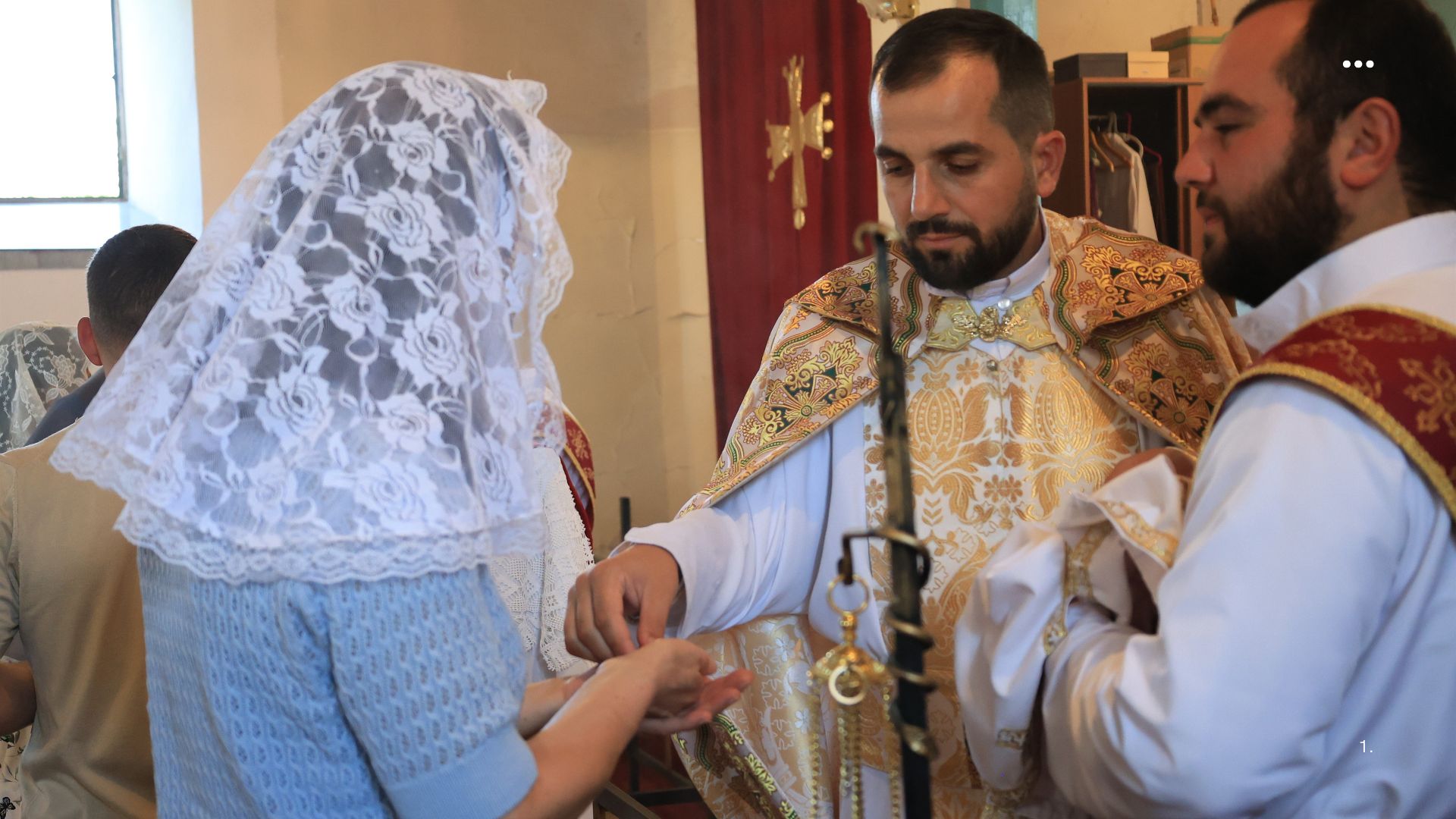
On a calm Sunday morning, in the small village of Verin Dvin—home to Armenia’s largest Assyrian community—the courtyard of the Mar Thuma Church was already filling with people. The early autumn light fell softly on the stone walls as families arrived one by one, greeting each other in a mix of Armenian, Russian and Aramaic.
Children gathered in front of the church, smiling shyly at one another as their voices blended with the morning quiet. Teenagers lingered by the gates, scrolling on their phones and chatting until their mothers and grandmothers called them to join. The elders, wrapped in neatly tied scarves and carefully chosen dresses, walked slowly toward the entrance, exchanging quiet blessings as the liturgy was about to begin.
Inside, the service had already started, an ancient melody in Aramaic, the language spoken by Christ.
Outside, the low rumble of an engine interrupted the calm. Down the narrow village street, a large white bus inched its way toward the church, its engine humming through the quiet. It finally came to a stop near the gates, carrying Assyrians from Sweden, among them Janet Gorgis Thalia, who had travelled more than 3,000 kilometres to stand before this church.
Born in the northern Iraqi city of Duhok, Thalia later moved to Baghdad, where she lived until the war forced her family to leave. They resettled in Sweden nearly 30 years ago.
“This is my first time in Armenia,” she said. “We came as a group, and visiting the Assyrian community here was part of our program. But it was also my personal wish—I had always wanted to come.”
Stepping inside the Mar Thuma Church for the first time, she felt deeply moved.
“It was very emotional,” she said. “To attend the liturgy here, to hear the same prayers—it felt like I was back home in Iraq. It was warm, as if I were in my own country again.”
In Sweden, as in Verin Dvin, the Assyrian church bells still ring on Sunday mornings, carrying the same call across continents. The same prayers, the same survival—a culture held together by memory, ritual, and belonging.
Even as Assyrians like Thalia nurture their faith far from their ancestral homeland, the story they carry is rooted in loss, exile and survival.
This is the same story that genocide scholar Anahit Khosroeva, a visiting professor at Harvard University’s Department of Near Eastern Languages and Civilizations, has dedicated her work to naming the Assyrian Genocide.
The Assyrian people were among the Christian groups, alongside Armenians and Greeks, targeted by the Ottoman Empire during its genocidal campaign in World War I. Her research estimates between 250,000 and 500,000 Assyrians—about two-thirds of the nation at the time—were killed across what is now southeastern Turkey, northern Iraq, and Iran.
For decades, the Assyrian disaster lived only in oral tradition. It was remembered as Sayfo — “the sword”—a word passed down through generations of survivors. Only later, as the Assyrian diaspora got more organized, that memory turned into a movement and gained a political form.
The first milestone came in 2007, when the International Association of Genocide Scholars, where Khosroeva has been an active member, recognized the Sayfo as genocide.
“Unlike Armenians, who began their recognition efforts in the 1960s, it was only in the late 1990s and early 2000s that Assyrians started their own,” Khosroeva said.
That very process of recognition soon raised a deeper question: Should the Assyrian Genocide be viewed as part of the Armenian tragedy, or as a separate plan of extermination?
“We need to answer this question,” she said. Drawing on years of archival research, Khosroeva argues that the two must be compared but viewed separately.
“Even in Talaat Pasha’s orders, there are notes saying not to touch the Assyrians,” she said. “Yet they were targeted through a different plan, caught in the same machinery of murder, by the same perpetrators.”
Three years later, in 2010, Sweden’s Parliament passed a resolution acknowledging all three—Armenian, Greek, and Assyrian genocides.
“For decades, we relied on Armenian advocacy,” she said. “And finally, Assyrians led the way. There are many Assyrians in Sweden, and they worked hard to make it happen.”
Activists later built new alliances with Armenian associations to coordinate joint events for the centenary of the massacres of Christians in Ottoman Turkey, demonstrating how coalition-building among diasporas became an effective mechanism in the struggle for genocide recognition.
Recognition has since spread in a fragmented but steadily growing pace. In the United States, several state legislatures have passed resolutions; the same happened in Australia. And in 2015, a month before the centennial of the Armenian Genocide, Armenia’s National Assembly voted to recognize the genocides of the Assyrians and Greeks.
“I remember being there,” she said. “I told them: the same people were exterminated alongside you. If you don’t recognize their genocide, how can you ask others to recognize yours?”
Her own story, too, is marked by loss and recovery.
Born in Vanadzor to an Armenian mother and an Assyrian father, she grew up without her ancestral language. During Stalin’s repressions, her grandfather was sent to Siberia on espionage charges.
“He was accused simply because he was from Urmia, Iran, and automatically seen as a spy,” she said.
Her father was a child then, and there was no one left to teach him the language.
“This loss of language is also a consequence of genocide,” she added. “I regret not speaking Assyrian, so I compensate with research, with teaching, with making sure the story is not forgotten.”
Even so, she never planned to study genocide. At first, she even accepted a different topic for her doctoral dissertation.
That changed in 1999. Close to April 24, with a delegation of Assyrian guests from the United States due to arrive in Yerevan, Khosroeva was unexpectedly asked to prepare a short report on the Assyrian Genocide.
“Back then, you couldn’t find a single reference in Armenian,” she recalled. “I found a few French sources, had them translated, and wrote what I could.”
Then her father said the words that would change her path: “‘If you’re not going to write about it, then who will?’”
Her father’s challenge became a lifelong pursuit. As her research deepened, she realized that the story of the Assyrian genocide did not begin or end with the massacres of World War I. That is reflected in the Assyrian Day of Remembrance, which marks not the massacres of 1915 to 1923, but what came later.
After the Assyrians fled in three directions: north, with the Russian army into Armenia, Georgia and Russia; east, into Iran; and south, into Iraq, where British forces established the Baqubah Refugee Camp.
“More than 55,000 Assyrians arrived there, along with several thousand Armenians,” she said. “British officers promised them a degree of autonomy in their historic homeland—a promise that would never materialize.”
When Iraq gained independence in 1932, those promises vanished. Within a year, the tension between Assyrians and the new Iraqi army turned violent. In early August 1933, government troops entered the northern town of Simele and, over several days, massacred between 3,000 and 6,000 Assyrians, according to Khosroeva.
“We commemorate August 7 as our Genocide Remembrance Day,” Khosroeva said. “Not because the Simele massacre claimed the most lives, but because it came to symbolize the Assyrian experience: survival, loss, and the demand to be seen.”
According to estimates by the Unrepresented Nations and Peoples Organization, the number of Assyrians worldwide is about 3.3 million. In Iraq, where there were some 1.4 million before the 2003 U.S.-led invasion, only 300,000 remain.
The rest live scattered across continents. “The only thing that still holds them together,” Khosroeva said, “is the church.”
The Assyrian presence in Armenia, however, predates those events by nearly a century. It goes back to the Russian–Persian War of 1826–28, when several hundred Assyrian families migrated from northern Iran and Turkey.
They settled in what are now Armenia’s four Assyrian villages: Verin Dvin, Arzni, Dimitrov and Nor Artagers.
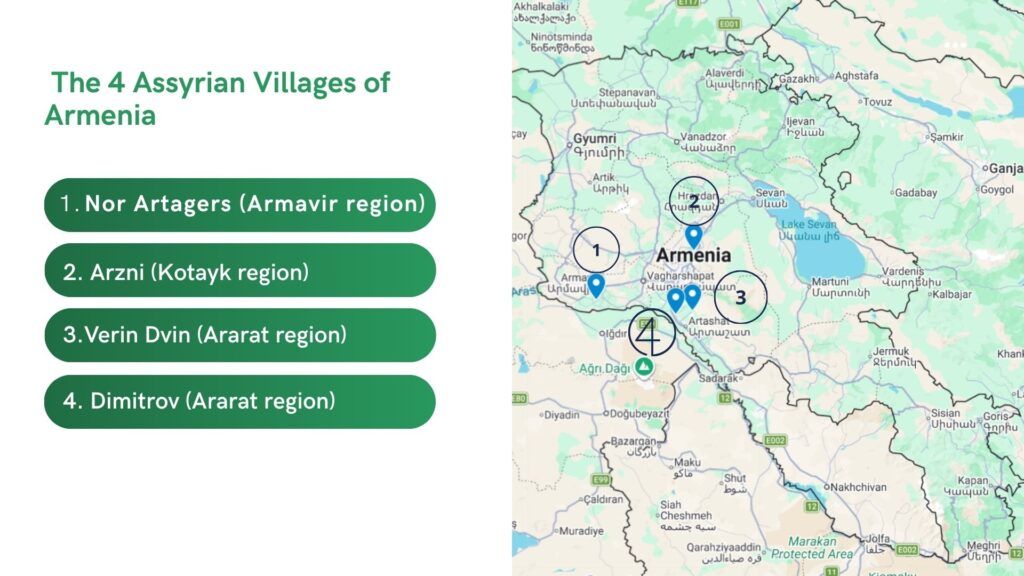
As of 2025, there are 3,340 registered Assyrians in Armenia, according to Armenia’s Migration and Citizenship Service of the Ministry of Internal Affairs.
The largest communities are in Verin Dvin with 1,234 residents, Arzni with 616, and the Artashat area with 415.
At the heart of this small but enduring community is the Assyrian Church of the East in Armenia.
Every Sunday, families gather to hear the ancient chants and speak a few words in the Aramaic liturgical language.
Still, the reach of the Assyrian Church extends far beyond these villages. In recent years, its role has gained new visibility.
“Now, Assyrians from abroad visit Armenia more often,” said Father Nikadim, priest of the Holy Apostolic Catholic Assyrian Church of East Armenia. He described the growing connection as a kind of “rebranding,” creating a link between Armenia’s Assyrian community and the diaspora.
The Mart Maryam Church in Arzni, an ancient Assyrian church restored in 2022 with support from the Assyrian Church of the East Relief Organization, became a symbol of that cross-border unity.
Besides the renewed ties with the diaspora, the community has also maintained close relations with the Armenian Apostolic Church.
The connection, Father Nikadim said, is “warm and brotherly.” At times, the two churches have come together for shared ceremonies—weddings, funerals—whenever Assyrians and Armenians share a family.
Still, even in harmony, there is fragility. The community’s openness and intermarriage are signs of calm coexistence, but they also carry the risk of assimilation.
“Yes, there is a danger,” he admitted. “Here, we feel free—maybe too free. Many marry Armenians, and the children often grow up more Armenian than Assyrian.”
Keeping the language alive has become another way of securing their presence.
In each of Armenia’s four Assyrian villages, the local schools operate in two streams: Armenian and Russian. In the Russian-language sections, students begin learning Assyrian from the first grade. Even in Yerevan, at the Pushkin School, Assyrian is taught as part of the curriculum—a chance not available to many Assyrian communities abroad.
There is no university program in Armenia that trains Assyrian-language teachers. Instead, the community relies on those who already know the language and have a background in education. The church verifies their fluency, and they are allowed to teach.
“Thank God, we have people,” Father Nikadim said. “If someone knows the language and wants to teach, they find their place.”
In Sweden, home to one of Europe’s largest Assyrian communities, the system works a bit differently.
“If at least five students enroll, the schools bring an Assyrian teacher,” said Thalia. “And at church, they also teach reading and writing. That’s how we keep the language alive.”
In Verin Dvin, the same effort begins in classrooms and continues in church halls. Assyrian is taught three times a week at the village school, which has Armenian and Russian sections. Most Assyrian children attend the Russian one, where the language is part of the curriculum.
“Our priests and teachers usually learned it at home,” said Iosif Abrahamov, 22, deacon of the Assyrian Church of the East. “That’s how we pass it on.”
Among the students are Sona Mnatsakanyan, Sara Sergeyeva, Milena Gevorgizova, Valentina Agakhanova, and Nona Hambardzumyan, who also gather for Sunday lessons. “We study the Bible, but it’s also about keeping our culture,” said Sergeyeva.
Cultural expression continues through music and dance. “We have two ensembles—Sargon and Atur,” said Valentina. “They perform on holidays and sometimes travel abroad. Dance is a big part of who we are.”
“The most popular one is sheikhane, but there are others like bagin,” added Iosif.”
For Sona, who recently earned a master’s degree at the Armenian State Pedagogical University, belonging extends into academia. Her research on Assyrian literary ties became one of the few scholarly works on the subject.
“There are so few studies about our language and culture,” she said. “For me, it was a chance to open that window and show others who we are.”
Their connection to ancestral lands remains strong. Some have visited Iraq—the historic heart of Assyria—for youth conferences and pilgrimages.
“When you’re there, you feel like you’re home,” said Nona. “Just as Armenians dream of Western Armenia, we feel the same when we go to Iraq.”
They recalled that in 2022, when the new patriarchal seat of the Assyrian Church was inaugurated in Erbil, young people from around the world gathered.
“Many of them no longer speak the language,” Valentina said. “But here, in Armenia, it’s still alive—we learn it, use it, and teach it to children.”
“That’s why I always say Armenia is one of the few places where the Assyrian language and faith are still practiced together,” Iosif said.
Between faith, school, and celebration, the younger generation has found its own way of survival. “We might live in a small village,” said Sona, “but every Sunday, every dance, every prayer reminds us of who we are.”
From Verin Dvin’s churchyard to Swedish suburbs, the pattern repeats: Sunday bells, familiar melodies, children learning old letters beside new ones. Church, language, culture: three anchors that keep scattered people present, visible, and whole.
Further reported and co-authored by Goharik Hovhannisyan.