

By Yeva Minasyan
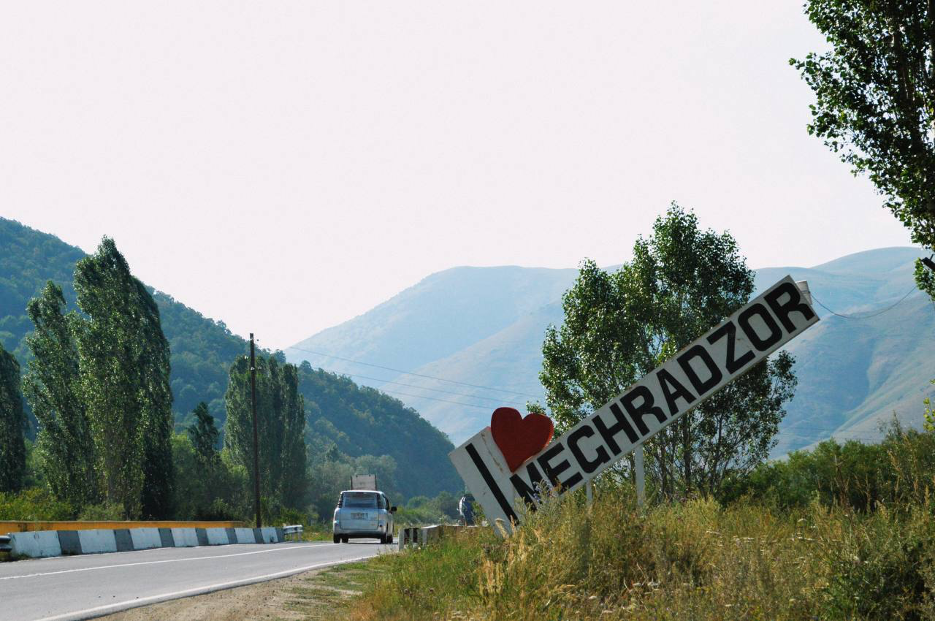
MEGHRADZOR, Armenia – In a village nestled among the forests of Kotayk Province – often dubbed “Armenian Switzerland” – the walls do more than hold up homes. They speak. Covered in bold color and memory, they tell stories of love, war, loss, myth, and strength.
This transformation of Meghradzor into an open-air museum is the work of PATMI Cultural NGO, a grassroots initiative founded by two friends determined to save their village from silence.
It all began with a casual conversation. While traveling through Chile, Sarine Arslanian stumbled upon a village entirely covered in street art. “Why can’t we do this in Armenia?” she asked her friend, Naira Harutyunyan, a native of the village Meghradzor. They had no money, no tools, not even paint. But they had stories.
“We went to a pub and started pitching the project to strangers,” Naira recalled. “We showed sketches and told stories. People we didn’t know gave us money.” It was enough to get started.
From that bold night in Yerevan to more than a dozen murals later, PATMI (“tell a story” in Armenian) has become a movement. Every painting on Meghradzor’s walls begins with a conversation – with grandparents, neighbors, and locals whose lives were worth drawing.
“I didn’t want to accept that life here had to be boring or invisible,” Naira said. “If we didn’t tell these stories, they would disappear.”
Their first step was listening. For weeks, Sarine and Naira sat with elderly villagers, notebook in hand, asking: What do you remember? Who were you before?

And something unexpected happened – people opened up. “Some of the grandkids heard these stories for the first time,” Naira said. “They were shocked. ‘My grandma did what?’”
From these memories came the village’s first mural in 2018: Nazan Tatik, a colorful portrait of a loving grandmother, created with children and painted by Armenian artist Sevak Nazaryan. Rubik Harutyunyan, great-grandson of Nazan, remembers her and says that it was a great joy for him that the painting was the first to be displayed on the walls of the village. Their house is located on one of the high points of the village, from there one can see several murals at once in the village surrounded by forests.
And something unexpected happened – people opened up. “Some of the grandkids heard these stories for the first time,” Naira said. “They were shocked. ‘My grandma did what?’”
From these memories came the village’s first mural in 2018: Nazan Tatik, a colorful portrait of a loving grandmother, created with children and painted by Armenian artist Sevak Nazaryan. Rubik Harutyunyan, great-grandson of Nazan, remembers her and says that it was a great joy for him that the painting was the first to be displayed on the walls of the village. Their house is located on one of the high points of the village, from there one can see several murals at once in the village surrounded by forests.
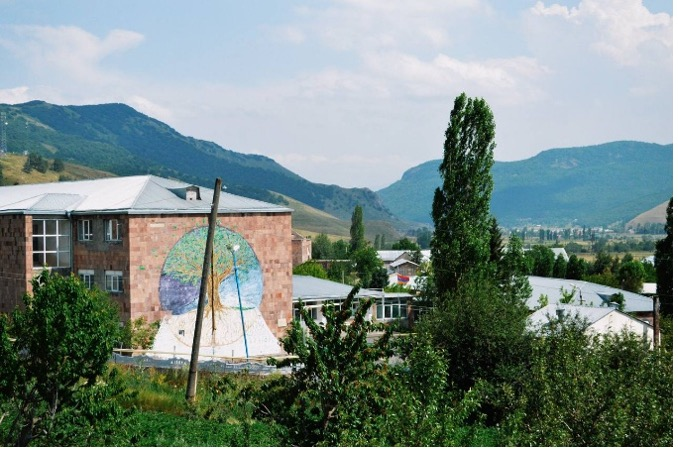
Since then, Meghradzor has become a visual tapestry of its people. PATMI has completed 13 large-scale murals and counting – each one born from the memory of someone who lives, or once lived, there. “It gave kids something to do after school. Something to be proud of,” Naira said.
Among the most beloved is Hope, which tells the story of a father during the Nagorno-Karabakh war who dreamed both his sons would come home – and they did. Another, The Cyclops, celebrates a local legend of a one-eyed giant, painted by Canadian artist Sloast and local youth. According to villagers, the enormous stones scattered nearby are the remains of this mythical creature’s wrath.
Then there’s The Price of Gold, based on a story told by villager Romik Voskanyan and painted by Moldovan artists BTA Krew. A greedy priest is betrayed by his new wife, who slowly steals his hidden golden coins. In fury, he curses any Meghradzor resident who marries into the neighboring village of Aghavnadzor – a warning still whispered today.
One of the eeriest tales-turned-mural is The Girl Who Haunts the Milky Spring. A ghostly figure in white, seen repeatedly near the village’s famed spring, eventually drove locals to light candles and place crosses around the site. Soon after, the water dried up. The mural, drenched in pale hues, is a haunting tribute to that loss.
But some murals come from truth, not legend.
Nusho, the Wolf Killer honors a villager who fought off a rabid wolf with a coat and a stick. Fearing an outbreak, residents held an all-night vigil in the village church. After learning the stories through the walls, the young people of the village began to look for stories in their homes. “After hearing about the wolf, everyone was talking about how their parents had also seen wolves, bears, we all wanted to have our own story”, said Hasmik Tigranyan, one of the young villagers. “The murals made the village colorful and did not let you get bored or leave.”
The most recent piece, Hero Mothers, painted by Brazilian artist Julianna Nersesian, immortalizes six women who raised 10 or more children each during Soviet times. “They were strong, but people had forgotten their names,” Naira said. “Now, they’re remembered – like they always should have been.”
Behind each painting is deep collaboration. The organization brought volunteer artists from different parts of the world – Canada, Brazil, Moldova – who stayed in the village and got to know the local culture. “Some of them even wanted to buy houses here, but they didn’t have enough money, because Meghradzor is the Armenian Switzerland anyway,” said Alisa Tadevosyan, who had hosted the invited artists many times.
Sometimes, villagers were wary. “At first, some people didn’t want anything drawn except churches or trees,” Naira explained. But that changed after the first one. Once one of the artists with colorful tattoos and braids began sketching near a local home. A group of elders gathered, and Naira braced for criticism. Instead, the villagers were full of curiosity. “They asked where they could get tattoos like hers,” she added. “That’s when we knew we were breaking through.”
The project hasn’t just brought in artists – it’s kept youth from drifting away.
Tigran, once a quiet teenager fetching brushes, started painting murals himself. Numerous bees around the village are something he left before going to army.
What started as a dream between two women is now a visual archive of rural Armenia. In Meghradzor, even the walls remember stories.