

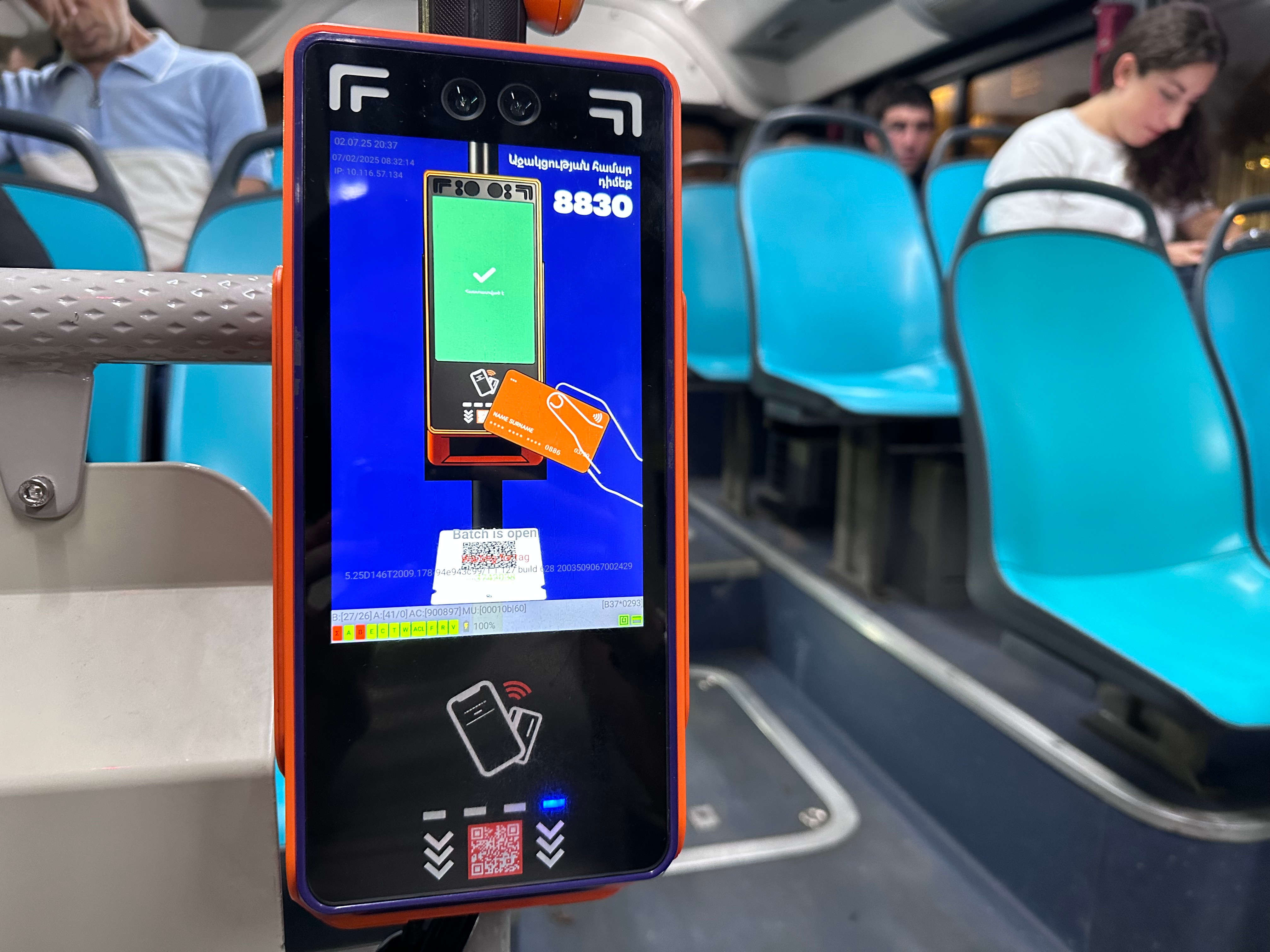
Every morning, 50-year-old Anna Arshakyan takes the bus to get to her job in the city center. When the price for a single ticket spiked to 150 drams ($0.37) at the start of 2025, it put a strain on her budget. Now the prospect of any future increase worries her even more.
“150 drams was already bad,” she said. “Any further increase will only make it worse.”
Arshakyan is one of more than 200,000 daily commuters, who had to tighten their budgets after the new prices were introduced. For about the past six months, Yerevan commuters have been using the new system featuring a 50% increase from the 100 drams they paid per ride for over 30 years. It is a200% increase from the 50 drams trolleybus fare.
Yerevan authorities introduced a new digital system in tandem with the price hike. City officials expected most passengers to switch to packages of tickets, instead of individual fares, in keeping with the practice in many other countries. The plan did not at first include a single-ticket option, offering only a 300-dram ticket ($0.79) valid for three rides within 90 minutes. That sparked huge public backlash among commuters used to paying 100 drams per ride.
Political opposition and civic groups announced boycotts demanding a price review. To avoid further backlash, just a few days before the planned boycott, Mayor Tigran Avinyan introduced a new single ticket priced at 150 drams, effective throughout 2025. The move calmed tensions and undermined the protests.
“That decision was the biggest hit to the boycott,” said Yuri Movsesyan, coordinator of the “Chenq Vcharelu” initiative (in Armenian “We are not gonna pay”). “If they hadn’t introduced the 150-dram ticket, it would have been far more successful. Even amongst our fellow activists, some considered 150 drams an acceptable price given transport improvements.”

“We were alone and did not have enough resources,” Movsesyan explained. “The initial excitement faded, and at some point, we had to stop. It could not go on forever.”
Although many have accepted the 150-dram fare, concerns remain about increases in coming years. There are two main reasons prices might go up. First, Mayor Avinyan said in January that fares may be subject to increases of up to 10 drams per year after 2025. Telcell Deputy CEO Liana Hunanyan, who heads the company’s unified payment system project, believes the increase is likely.
“We can consider this as part of natural inflation needed to maintain services or buy new buses,” Hunanyan said.
Movsesyan doubts that an increase will happen ahead of upcoming parliamentary elections in 2026.
The next potential increase could happen after Oct. 28, 2028, when Telcell, the operator of the unified ticketing system, stops covering all the operational and transactional costs. Currently, the company operates the system at its own expense, hoping to attract new users to its Telcell Wallet app. After 2028, whoever takes over the system will collect transactional fees.
“Someone will have to cover those expenses,” Hunanyan said. “And we all know that the burden always falls on ordinary people.”
The city municipality did not respond to requests for comment about future fare changes or plans to adjust package prices.
Telcell has invested around 1.5 billion drams ($3.9 million) in the new system so far. However, it has not worked as planned. About 75% of passengers continue buying single tickets, while the initial plan envisaged 80-90% of all commuters buying packages. According to Hunanyan, only two packages remain relatively popular: a 10-ride ticket, which offers no discount but is convenient, and a 180-minute ticket for 280 drams (through Telcell Wallet) allowing three rides.
“They introduced the 150-dram ticket, but failed to review prices for the packages,” Hunanyan said. “This totally disrupted the whole idea of the project.”
She said she suggested lowering prices for the packages for the system to work, but officials rejected the idea, explaining that would mean reducing the price below 150 drams per ride — something they are not willing to do. She also proposed keeping the old price for a while to allow people adjust to the new system, but officials dismissed the idea.
“Most people already had a deep dislike for the system, when it was first launched,” Hunanyan said.
In comparison, neighboring Georgia has more affordable options. In Tbilisi, passengers can buy a three-month card for around 100 GEL ($37), a six-month card for 150 GEL ($55), or a one-year card for 250 GEL ($92) – significantly cheaper than in Yerevan, where a one-year card costs 90,000 dram ($235) or 88,000 drams in the Telcell Wallet app.
Despite the changes, around 25-30% of users still do not pay for public transport, according to Deputy Minister of Territorial Administration and Infrastructure Armen Simonyan.
Some Yerevan residents say they are are going with the flow for now.
“The price is definitely acceptable,” said Lilit Markosyan, 31. “I would even say it’s very good, because the situation is significantly different from what we used to have”
Still, Markosyan avoids using public transport during the rush hour, saying the system has a long way to go before it is convenient enough.
But for people like Armine Grigoryan, 40, who takes the bus twice daily, five times a week, the uncertainty is troubling.
“If the fare goes up to 160 drams or higher, I might stop using it or just ride without paying like everyone else,” she said. “They aren’t giving us better service anyway.”