

Maria Azaryan, 29, didn’t expect to uncover a piece of Armenia’s hidden history when she entered the Matenadaran on the evening of May 17. It was Museum Night in Yerevan, and she and her friends were drifting from one museum to another when they stepped into Matenadaran’s educational and cultural hall.
A side door, just to the right of the main entrance, led them to an exhibit called “Between Science and Faith: The Sacred Manuscript of the House.”
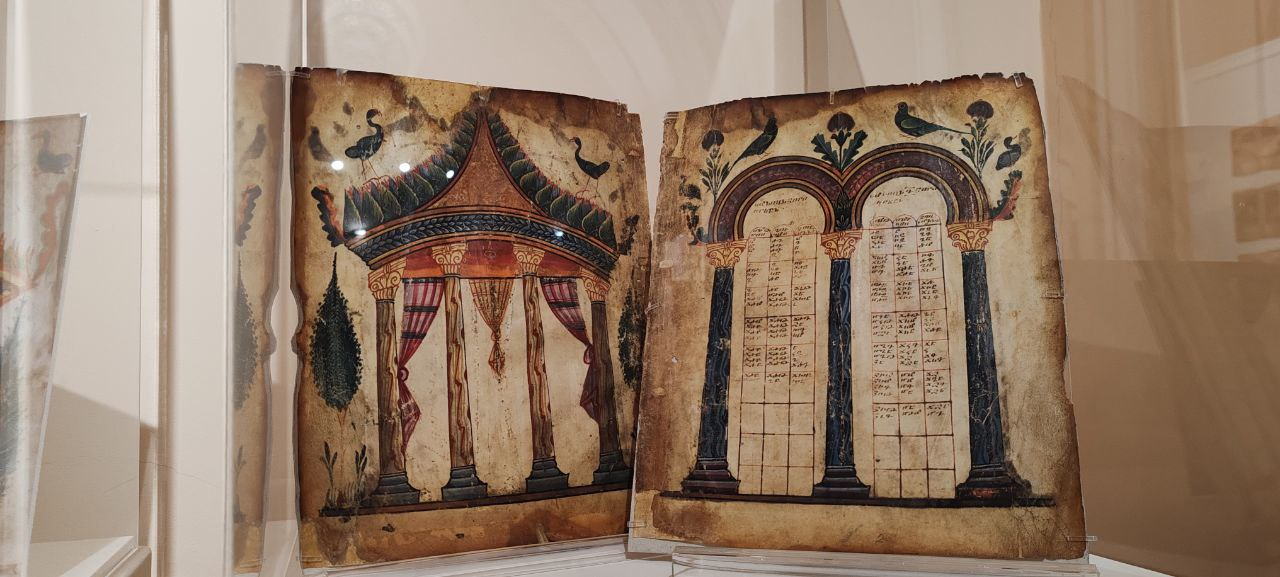
Inside the hall, rows of white arches framed what appeared at first glance to be ordinary images. They turned out to be digitized versions of sacred manuscripts — not from archives, libraries, or monasteries, but ordinary households. Many had been preserved by Armenian families through violent upheavals from the Russo-Turkish wars of 1828–1829 and 1877–1878 to the Armenian Genocide of 1915–1923.
Beside similar manuscripts from Matenadaran’s own collection, what caught her attention wasn’t a script, but a man standing quietly among the displays and showing visitors the sacred book his family kept.
“The scene was incredibly moving,” she said. “What struck me was the realization that there must be many more of these books hidden in people’s homes, the existence of which isn’t even known.”
The exhibit marks the culmination of a decade-long journey by Hayk Hakobyan, a senior researcher at the Matenadaran—Mesrop Mashtots Research Institute of Ancient Manuscripts.
With the zeal of an archaeologist and the instincts of a detective, Hakobyan has spent the past 10 years knocking on doors in Armenia’s rural villages, asking an unusual question: Where is the saint of your house? He uses the phrase to show the sentiment many families hold toward their household manuscripts.
The journey began in 2015, during a field study of epigraphic sites. While exploring an inscription, a villager approached him and described an “interesting book” kept in his town’s small chapel. It turned out to be a copy of “Urbatagirk” or “The Book of Friday” — the first printed book in the Armenian language.
That moment changed everything.
“I realized immediately that without documentation, digitization and mapping, this entire layer of culture would be lost,” said the researcher.
For years — until 2019, when the project received funding from the Calouste Gulbenkian Foundation, and later from Italy’s National Research Council and Armenia’s Science Committee — Hakobyan paid for the work himself.
“I had to be strategic,” he said. “I travelled only to places where I thought the chance of discovery was high. I couldn’t afford to waste time or money.”
Hakobyan turned to ethnographic journals and village memoirs, looking for any hint of sacred culture hidden in everyday life.
Another important source of information came from local drivers — guides with a deep knowledge of backroads and village life. “Though their help is rarely free,” he added.
“I carry a high-resolution camera and white paper sheets for backdrops,” he explained, sitting behind his desk covered with books and papers that leave just enough room for a laptop and a coffee cup.
Often, the owners won’t let the manuscript leave the chapel or its designated space, so he has to work on-site. To reach that stage, he also brings sweets for the hosts — a gesture that says, “May my footsteps bring blessings to your house.”
To date, Hakobyan has found around 60 manuscripts, 20 of which are hmayils — protective amulet scrolls once carried by merchants and emigrants that were especially common in the wake of the Armenian diaspora.
Summer is the most active season for the search, the expert said. He travels almost every week, working to keep that pace through September and October.
Winter trips are rare for him, as some villages are seasonal and houses remain sealed during the cold.
“I found them mostly in Shirak, Gegharkunik, Aragatsotn and Kotayk — a few in Lori, Armavir and Ararat — but I haven’t met any in Tavush, Vayots Dzor, Syunik or Artsakh,” Hakobyan said.
The most recent finds were digitized a week ago. One was a “Book of the Six Thousand” — a text of so-called “black magic” used for summoning demons to do one’s bidding. The other was a medical-magical ephemeris.
Roots of a Calling
Hakobyan’s passion for history began long before his academic career — back in the village of Norashenik, near his hometown of Kapan in southern Armenia. As a boy, he would run away from home and spend hours in the village’s abandoned 19th-century church, Surb Astvatsatsin.
“My grandmother would find me in the church,” he recalled.
“I don’t even remember what I was thinking or feeling. I’d chase the cows and calves out, sweep the floor, and just sit inside․”
Every time Hakobyan returns to the village, he makes his way back to that church.
“I sweep its floor and tell my 13-year-old son, Aram, the stories my grandfather once shared with me. ‘Live your life so that one day you, too, will have a son and will keep this door open,’” he said.
Sometimes, Aram joins him in the field. On one early trip to Vorotnavank Monastery in Armenia’s southernmost Syunik region, Hakobyan laid his sleeping son — then just 3 years old — on a tombstone and continued working.
“There were beautiful bird songs in the air,” said Hakobyan.
Later, he saw that the “chirping birds” were actually snakes slithering inside the hollow church walls.
“He slept surrounded by them for two hours,” Hakobyan recounted. An old man nearby told him they’d never bitten anyone. Then he found out Vorotnavank was once famous for its snake remedies.
Pursuing another childhood dream, Hakobyan went to Germany — a country he “admired” for its scientific excellence — to earn a postgraduate degree at the Martin Luther University in Halle-Wittenberg.
There, at the Department of Christian Orient, he became interested in folk Christianity — the ways people express faith outside of formal doctrines.
It isn’t his academic credentials that earn Hakobyan the trust of those who keep sacred scripts. One of the manuscripts only became accessible to him because of a dream of the owner’s wife.
“I saw the saint last night — and this young man looks like him,” she told him. That simple declaration opened the door to Hakobyan.
“Sometimes people trust you. Sometimes it’s pure chance or faith,” he said.
Tatevik Manukyan, a senior researcher at the Matenadaran’s Department of Manuscript Studies, also speaks to this delicate balance between scholarship and belief.
A contact once led her to a potential manuscript owner, but when she asked to visit and explore the script, the request was met with a firm refusal.
“If the manuscript wants to be studied, it will come to me in a dream,” the owner told her.
How Beliefs Take Shape
Harutyun Marutyan is among the first scholars to shed light on one of Armenia’s lesser-known spiritual phenomena. A leading researcher at Armenia’s Institute of Archaeology and Ethnography, he has spent decades exploring how sacred objects shape memory and identity.
“Armenians are often described as a ‘nation of book lovers,’ yet I argue it wasn’t the books themselves they cherished, but the sacred power attributed to them,” he said.
Some of these texts bear striking names —“Merel Haruyts” or “Resurrector of the Dead.” They are believed to hold healing powers and said to cure grave illnesses and free one from evil.
Even today, people bring loved ones suffering from seizures or mental illness to sleep beside these holy books, watching and waiting for dreams that might promise recovery.
Marutyan is currently working with Hakobyan on a new article on the saint of the house. Yet their views differ in subtle ways.
“The difference between Hayk and me,” Marutyan said, “is that for him, the sacred object itself is central, whereas for me, it’s about the social relationships it creates.”
Hakobyan agrees that once manuscripts enter museum collections, they often lose their ritual and sacred functions.
“Some — like the Gospel of Shurishkan — are still venerated,” he said.
“But most lose both their purpose and their traditional names: The Old Gospel, Grandfather’s Gospel, The Red Gospel, The Green Gospel. These names fade away,” he added,
The oral, intangible layer of memory disappears, while in homes across Armenia’s villages and towns, the manuscripts and the rituals surrounding them continue to endure.
There is another reason why owners may refuse to open a manuscript to researchers.
“This phenomenon of sacred household manuscripts has existed since the 16th or 17th centuries,” said Hayk Hakobyan.
At the time, few villagers could read. It was the priest’s responsibility to open and interpret the texts. Until then, the books remained closed—resting silently until summoned for ritual use.
Over time, especially during the Soviet era repressions when priests were often “absent,” as Hakobyan described the Stalin era, this waiting turned into prohibition. Clergymen faced severe persecution, including arrests, executions, and suppression. As a result, no one could open the manuscripts, even if they understood classical Armenian.
“That’s what Garegin Hovsepian, a scholar of Armenian art and Catholicos of Cilicia of the Armenian Apostolic Church, meant when he wrote, ‘A closed book is an idol,’” Hakobyan said.
Armenians never embraced iconography to the same extent as other Orthodox traditions replete with icons. Instead, Marutyan explained, they elevated the household manuscript to a similar sacred status.
These books were placed carefully—often in handmade chapels or corners of the home set apart from bedrooms, kitchens, and toilets. No food, no bodily intimacy, no impurity was permitted near them.
New Culture of Preservation
Hakobyan estimates that at least 200 more manuscripts remain hidden across Armenia. For him, digitizing them means preserving oral memory and giving them “digital immortality.”
A similar mission is unfolding in Paris, led by Chahan Vidal-Gorène, the founder of Calfa, who is building an AI-powered world index of Armenian manuscripts.
His journey began in 2014, when he bought the last classical Armenian-French dictionary called “Calfa” from the now-closed Samuelian Oriental Bookstore in Paris.
At the time, Vidal-Gorène was studying classical Armenian at Inalco, France’s National Institute for Oriental Languages and Civilizations. But it wasn’t long before he hit a wall.
“It’s incredibly difficult to read these documents if you don’t know how to decipher the historical scripts,” he said.
He turned the challenge into a mission, carrying the name “Calfa” into a larger AI-driven project to digitize, preserve and open access to Armenian and other Oriental languages.
“With ‘Calfa,’ 1,000 pages can be processed within an hour.”
What followed was a long-term effort to build a tool that could automatically read and transcribe handwritten Armenian texts using artificial intelligence.
Today, Calfa works with public metadata from national libraries and cultural institutions in nearly 30 countries. The index already includes more than 2,500 manuscripts.
“The index is the first door,” said Vidal-Gorène. “It opens access for researchers to explore Armenian heritage. And we will keep going until the very end.”
Back in Yerevan, Hakobyan supports the mission.
“I personally haven’t worked directly with Calfa,” he said, “but some of our researchers have uploaded manuscripts I discovered into the system.”
He added, “It’s truly remarkable work. And if I had the means, I would make every digitized manuscript we’ve found available online for the world to explore.”