

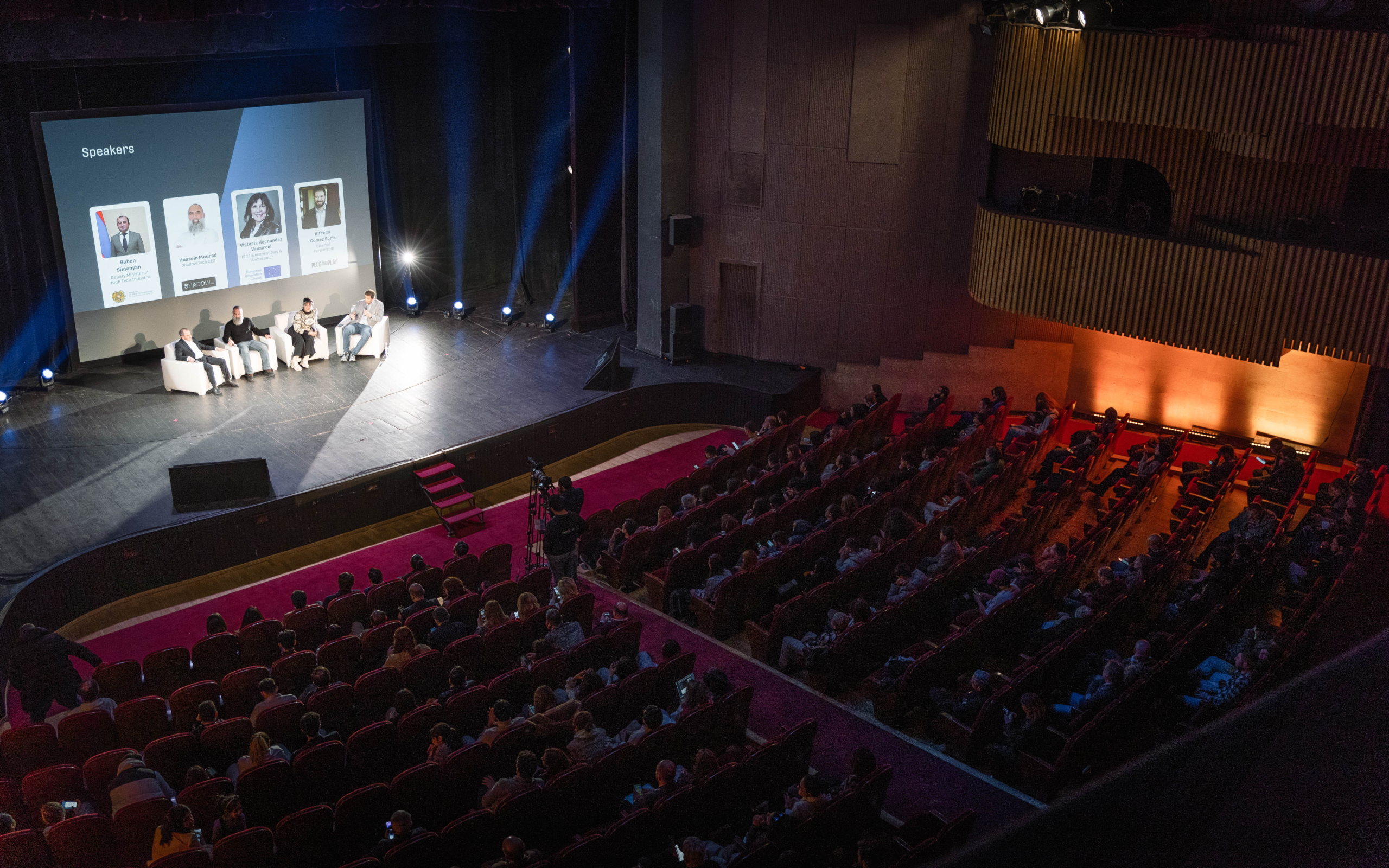
Plug and Play, the Silicon Valley accelerator operating in more than 60 locations, is deepening its bet on Armenia’s tech sector with a new round of startups joining its second acceleration program in Yerevan this October.
Hosted at Engineering City in Bagrevand—a purpose-built campus for advanced engineering and R&D companies—the launch brought together the Minister of High-Tech Industry Mkhitar Hayrapetyan and Deputy Minister Ruben Simonyan, startup community representatives, international mentors and alumni from the program’s first batch.
The new batch includes 20 local and international startups specializing in artificial intelligence, green technologies, logistics optimization, healthcare, enterprise software and professional services. Selected from 109 applicants, these teams were chosen for their scalability and potential to compete on global markets. Over the next four months, from October to February, participants will receive intensive mentorship, attend expert-led workshops and gain access to investment networks designed to accelerate their international growth.
In his opening remarks, Minister of High-Tech Industry Mkhitar Hayrapetyan described Plug and Play’s three-year presence as part of Armenia’s broader strategy to become a regional innovation hub. He noted that Armenia climbed three places in the Global Startup Ecosystem Index in 2024, reflecting the impact of international partnerships like Plug and Play.
“The presence of an international accelerator in Armenia is of great importance,” Hayrapetyan said. “It aligns with our strategic goal of bringing new knowledge and experience to Armenia.”
His remarks reflected the government’s growing reliance on global accelerators like Plug and Play to turn policy ambitions into practical support for early-stage startups.
Building on that vision, Alfredo Gomez Soria, Plug and Play’s director of partnerships, described the accelerator’s mission in Armenia as part of a long-term strategy to help startups move from prototyping to global scale.
“Plug and Play’s focus here is to support startups at the earliest stages of product development,” he said. “We continue to prioritize acceleration, helping startups scale and become part of our 2,.600 portfolio startups.”
With Plug and Play committing to three years in Armenia, local startup leaders are watching closely to see how international expertise translates into lasting growth.
Ruben Osipyan, CEO of the Science and Technology Angels Network (STAN), startup mentor and entrepreneur, emphasized that Plug and Play fills the gaps in acceleration programs within Armenia’s innovation ecosystem.
“As most players in our startup community would agree, we’ve long needed structured acceleration programs,” Osipyan said. “SmartGate, a local accelerator, implemented eight batches and then stopped; since then, we haven’t had a large-scale program like this,” he said. “Our ecosystem also needs diversity—we often operate within our own bubble trying to build and scale using mostly Diaspora connections.”
Osipyan also underscored the importance of managing both government and community expectations.
“Of course, we’d all love to see 20 unicorns emerging from Plug and Play’s batches by 2028,” he said. “But what matters more is how we value this opportunity long-term, how we strategically choose sectors, leverage the Armenian Diaspora and use this partnership to scale our ecosystem sustainably. These are the questions the Government and the ecosystem should be addressing first.”
For the startups themselves, Plug and Play’s presence in Armenia has already begun to reshape the expectations.
Karlen Madoyan, co-founder and CEO of doodooc, joined the first Plug and Play Armenia batch with his AI platform for musicians that generates live visuals from uploaded tracks and now has over 48,000 users. Before that, he had taken part in smaller accelerators like SmartGate, where his team built the startup’s foundations—but Plug and Play felt different from the start.
“I first heard about Plug and Play from the startup community and decided to apply,” Madoyan said. “Their network changed everything—it opened doors we didn’t even know existed,” he added laughing. “Through one of their mentors, we travelled to Saudi Arabia, signed an MoU, and are now preparing to expand there,” he added.
While Madoyan’s story shows how global exposure can transform a young startup, others in the new cohort are just beginning that journey—this time with direct access to world-class mentors from day one.
For Gera Avagyan, co-founder and COO of TAOS, a medical startup helping insurers and healthcare providers cut costs through early risk detection and prevention, the opportunity lies in Plug and Play’s access to mentors who have built and scaled companies worldwide.
“We had been talking to many local angel investors and mentors but often couldn’t get the value we needed,” Avagyan said. “Startups grow as we decide to, but we also need our local mentors, VCs, and angels to grow and learn with us—to be ready to share practical knowledge and experience in product development, entering international markets, and preparing for investment rounds. In all these areas, Plug and Play does its job greatly.”